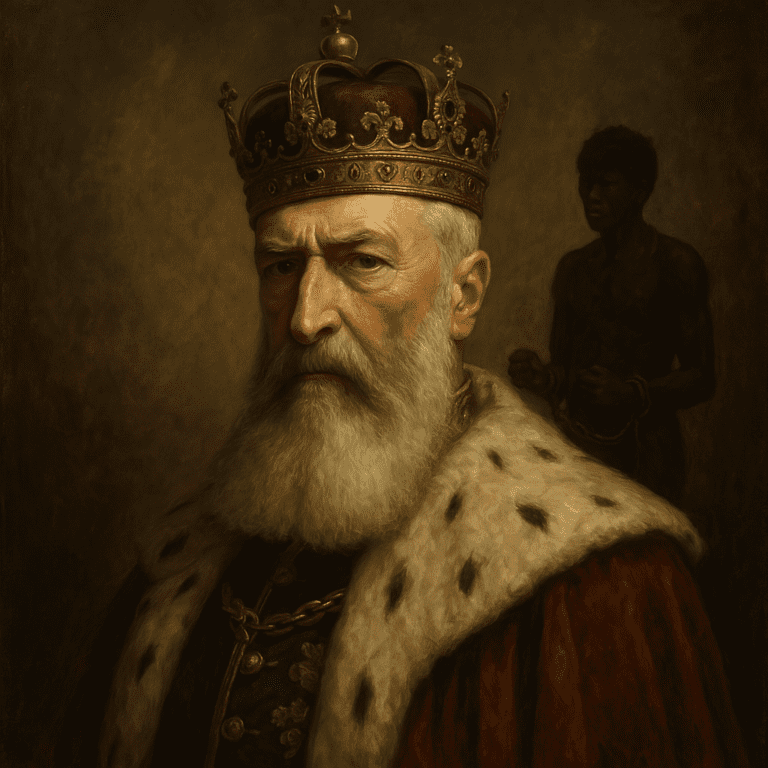
King Leopold II: The Ghost King Who Killed 10 Million Africans—And Still Escaped Judgment
By HawkFeed News | The History They Don’t Want You to Remember
Who was King Leopold II? A European monarch? Yes. A master of manipulation? Definitely.
But above all, he was one of the deadliest men in recorded history.
And yet—his name rarely stirs outrage. Why? Why has the world forgiven—or forgotten—a man whose regime butchered, starved, and mutilated over 10 million Africans?
This isn’t just a history lesson. This is a reckoning.
The Rise of the Butcher King
Born in 1835, Leopold II was the second King of Belgium. By all accounts, he was a frustrated royal. Belgium was small, landlocked, and not as powerful as its imperial peers—Britain, France, Spain.
But Leopold had a dark dream: he wanted a colony to make Belgium rich—and himself richer.
So, in the late 19th century, during the “Scramble for Africa,” he seized his chance. He didn’t just colonize Congo through the Belgian state. Oh no—he did something far more sinister.
He bought the Congo as personal property.
Yes, you read that right. In 1885, under the guise of humanitarian aid and “civilizing the savages,” Leopold convinced Europe to grant him ownership of what became the Congo Free State—a land 76 times bigger than Belgium.
From that moment on, Congo was not a colony. It was a plantation, a prison, a slaughterhouse—all owned by one man.
What Happened in the Congo?
Leopold’s empire was built on rubber and ivory, two commodities in high demand due to the industrial boom.
To maximize profit, he established a system of forced labor. Congolese men were kidnapped from villages and ordered to harvest wild rubber from the forests. The quotas were insane. And if they failed?
- They were whipped with the chicotte—a cruel whip made from animal hide, capable of tearing skin off the bone.
- Their wives and children were taken hostage, often raped or starved.
- Hands were cut off to prove bullets weren’t wasted.
- Villages were burned. Babies were killed. Men were executed.
It wasn’t just brutality—it was a business model of fear.
The soldiers, known as the Force Publique, operated under one rule: Meet the quota, or eliminate the workers. And the world? It looked away.
How Many People Did He Kill?
The numbers are chilling.
Historians estimate that over 10 million Congolese people died under Leopold’s regime between 1885 and 1908. That’s nearly half of the entire population at the time.
“The loss of life was so vast it resembled a silent genocide,”
— Historian Adam Hochschild, author of King Leopold’s Ghost
But why such a massive death toll?
- Forced labor killed thousands through exhaustion, beatings, and execution.
- Starvation followed as men were taken from fields and villages stopped farming.
- Disease spread due to overcrowded labor camps and malnutrition.
- Psychological collapse and suicide soared as entire communities were destroyed.
And here’s the sickening part—Leopold never set foot in Congo. He orchestrated it all from his palace in Brussels while receiving billions in modern-day profits.
How Was This Allowed?
Because he lied to the world—and the world believed him.
Leopold painted himself as a philanthropist. He claimed to be on a Christian mission to end the Arab slave trade and bring civilization to Africa.
And to an extent, it worked. For years, the world bought the myth.
Until a few brave individuals began speaking out.
- George Washington Williams, an African-American journalist, called it what it was in 1890: “A secret, barbarous slave state—a crime against humanity.”
- E.D. Morel, a British clerk, noticed that ships from Congo carried only rubber and ivory out, and guns and chains in.
- Roger Casement, an Irish diplomat, traveled to Congo and published a damning report based on survivors’ testimonies.
Their efforts sparked the first major international human rights campaign of the 20th century.
The Fall of the Tyrant—Or Was It?
By 1908, public pressure forced Leopold to relinquish control of Congo. But he was never held accountable. In fact, he destroyed most of his records before his death in 1909.
When he died, Belgians celebrated him as a hero. Streets, statues, and buildings were named after him.
And the Congo? It was handed over to the Belgian government, which continued exploitation—only with better PR.
There were no trials. No reparations. No global reckoning. Just silence.
Why Don’t We Talk About This?
Let’s ask the hard questions:
- Why is King Leopold II not taught in schools alongside Hitler or Stalin?
- Why aren’t there museums or movies or remembrance days for his victims?
- Why does Belgium still have statues honoring him?
Because he was European. Because his victims were African. And because history protects the hands that write it.
The West has long struggled to confront the horrors of colonialism. It’s easier to label it “civilization” than admit it was a genocide wrapped in greed.
Congo Today: The Unhealed Wound
Modern-day Democratic Republic of Congo still suffers from the aftershocks of Leopold’s rule:
- Instability and corruption rooted in the vacuum of post-colonial power.
- Mass poverty in one of the world’s most resource-rich nations.
- Generational trauma in communities that lost their elders, culture, and land.
Congo bleeds not just from new wounds—but old scars that were never treated.
Final Thought: What If the World Remembered?
Imagine if we told every child in school about Leopold II.
Imagine if we honored Congolese victims like we do those of Auschwitz.
Imagine if Europe truly reckoned with its colonial crimes—not with regret, but with responsibility.
Because King Leopold II wasn’t a footnote. He was a butcher with a crown, a businessman of genocide, a symbol of everything dark and unrepented in colonial history.
And 10 million souls deserve more than silence.
Quote 1:
“Leopold never went to Congo. He never held a whip. But he ruled like God and killed like Satan.”
— Congolese oral historian, unnamed survivor account
Quote 2:
“The silence around Leopold is not accidental. It is chosen. It is whitewashed. It is history’s dirtiest secret.”
— Journalist E.D. Morel