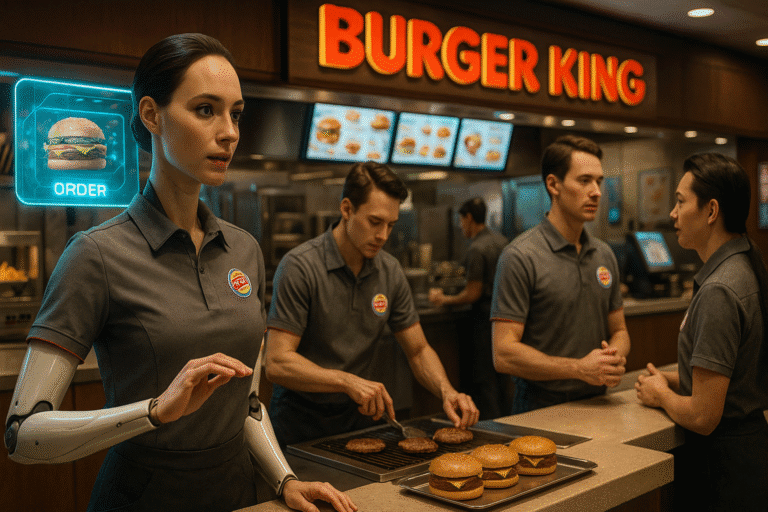
Under the bright heat lamps and behind the polished glass of drive-thrus, a quiet revolution is underway. Artificial intelligence (AI) is reshaping the way burgers are flipped, pizzas are assembled, and fries are perfection-tested—threatening millions of entry-level roles and creating entirely new classes of work. Here’s a CRN1-style exploration of how automation in the fast-food industry sparks a mass metamorphosis (complete transformation) of jobs, and what it means for workers, employers, and communities.
An Industry Built on Human Hands
Fast-food outlets employ roughly 3.6 million Americans, many of whom rely on these roles as their first job or primary income source. Teens cut their teeth as cashiers; career changers find steadiness as line cooks; families depend on predictable shifts flipping patties and manning pizza ovens. In towns large and small, quick-service restaurants have been ubiquitous (found everywhere)—the backbone of entry-level employment and a springboard to greater opportunity.
Automation Hits the Grill, the Oven, and the Counter
Robotic Burger Chefs
“Flippy,” a robotic arm developed by Miso Robotics, can cook up to 300 burgers per hour—monitoring temperature, adjusting cook times, and flipping patties with millimeter precision. Major chains are piloting these systems chain-wide, with plans to roll out 5,000 units by 2027.
AI-Guided Pizza Assembly
At select Domino’s and Papa John’s locations, vision-guided robots now spread sauce, sprinkle cheese, and arrange toppings in perfectly symmetrical patterns. These machines reduce ingredient waste by up to 15 percent and cut assembly times by 25 percent.
Smart Ordering Kiosks
Natural-language-processing kiosks handle millions of drive-thru and in-store orders, interpreting accents, upselling meal bundles, and integrating loyalty programs—with some chains reporting a 40 percent reduction in cashier headcount.
Combined across burgers, pizza, tacos, and coffee shops, these innovations will touch an estimated 4 million frontline positions by the end of the decade.
Mass-Scale Job Displacement in Numbers
- Burger Chains: If 50 percent of 200,000 outlets deploy robotic grills that replace 20 staff per location, that’s 2 million roles at risk.
- Pizza Franchises: With 17,000 U.S. outlets automating dough prep and topping stations—removing an average of 8 positions each—that’s 136,000 potential displacements.
- Sandwich & Taco Shops: Smart kiosks could replace 600,000 cashier jobs across Subway, Taco Bell, and similar chains.
In total, automation threatens roughly 2.7 million fast-food roles by 2028—nearly 75 percent of today’s workforce in the sector.
From Line Cook to AI Resource Manager
But displacement tells only half the story. New roles emerge to design, deploy, and maintain these systems:
- Robotics Supervisor: Monitors performance dashboards, troubleshoots misfires, and coordinates firmware updates.
- AI Interaction Specialist: Calibrates voice-recognition models to handle regional dialects and accents in ordering kiosks.
- Predictive Maintenance Technician: Uses sensor data to anticipate mechanical wear and schedule preventive repairs.
- Data-Driven Quality Analyst: Reviews computer-vision alerts for under-cooked fries or misaligned toppings, preserving brand standards.
These positions demand basic programming knowledge, system-diagnostics skills, and a knack for human-machine collaboration. They also pay 20–40 percent more than traditional fast-food roles—if workers can access the right training.
Bridging the Skills Gap with Rapid Retraining
To re-equip 2.7 million workers, educational institutions and industry players are piloting accelerated programs:
- 12-Week AI Technical Certificates at community colleges teach machine vision, sensor integration, and basic Python. Graduates report 80 percent job-placement rates.
- ApprenticeshipUSA Tracks blend on-the-job learning with classroom modules, allowing participants to earn while they upskill.
- Corporate Bootcamps sponsored by IBM’s SkillsBuild and Microsoft’s Global Skills Initiative enroll over 150,000 service-industry workers annually—offering free online courses in AI fundamentals and cloud-platform management.
These programs emphasize hands-on labs, real-world simulations, and mentorship—transforming line cooks into capable AI resource managers in under three months.
Who Foots the Bill? A Shared-Responsibility Model
Retraining at scale carries an estimated cost of $10,000 per worker—approximately $27 billion nationwide. Funding comes from multiple streams:
- Federal Grants (WIOA): Cover up to 80 percent of tuition and support services for displaced workers.
- State Workforce Boards: Match federal dollars, ensuring no region is left behind.
- Industry Coalitions: Fast-food giants pledge 1 percent of quarterly profits into a “Future Workforce Fund” to underwrite training and stipends.
- Tech Partnerships: AI leaders provide free modules and subsidized hardware for community colleges and nonprofit training centers.
This collaborative framework aligns incentives: employers invest in a skilled workforce, governments curb unemployment costs, and technology firms cultivate tech-savvy customers and operators.
Centering Human Strengths in an Automated World
Automation’s greatest gift may be liberating workers from repetitive tasks—allowing them to exercise creativity, empathy, and judgment. Instead of monitoring fryer timers all day, a Data-Driven Quality Analyst designs new flavor profiles based on consumer feedback. A Robotics Supervisor leads small teams that fine-tune machine parameters, ensuring both efficiency and food safety.
When frontline teams shift from rote preparation to problem-solving roles, companies report turnover declines of 25–30 percent and measurable gains in customer satisfaction.
A Future Defined by Collaboration, Not Conflict
The fast-food industry’s AI transformation isn’t a zero-sum game. With foresight and cooperation, we can turn mass displacement into mass upskilling—and create a more resilient workforce prepared for tomorrow’s opportunities. As these machines hum in kitchens and garages across America, workers will find themselves at the helm of a new era: from burgers and pizzas to bytes and predictive analytics. In this catalytic (causing significant change) moment, our collective challenge—and chance—is to ensure that no one is left behind.