If you’ve been anywhere near a cryptocurrency conversation, you’ve probably heard the term DeFi tossed around like a magic word. It’s often hailed as the future of banking, the destruction of traditional finance, or, for some, just another confusing tech buzzword. But at its heart, DeFi — short for Decentralized Finance — isn’t about revolution for the sake of drama. It’s about a slow, technical shift in how financial services are structured, built, and used.
Let’s dive into the real, unglamorous, but fascinating world of DeFi—minus the noise, and minus the marketing slogans.
What Exactly is DeFi?
At its simplest, DeFi refers to a system where financial products—like loans, savings accounts, trading platforms, insurance, and more—operate without centralized intermediaries like banks, brokerages, or insurance companies. Instead, these services run on blockchain networks, mostly using smart contracts—self-executing bits of code that automatically carry out transactions once specific conditions are met.
In short:
Traditional Finance = Banks, brokers, approval letters
DeFi = Code, consensus, instant execution
How Did DeFi Start?
The seeds of DeFi were planted when Bitcoin was created in 2009. Bitcoin proved that value could be transferred without banks. But Bitcoin was mainly about simple transactions—sending and receiving.
The real explosion came with Ethereum in 2015. Ethereum wasn’t just about sending money; it allowed programmers to build smart contracts—automated scripts that could manage money without human intervention.
From there, decentralized lending platforms, decentralized exchanges (DEXs), yield farming protocols, insurance pools, and even decentralized stablecoins (like DAI) emerged. The DeFi ecosystem started growing quietly—piece by piece, code by code.
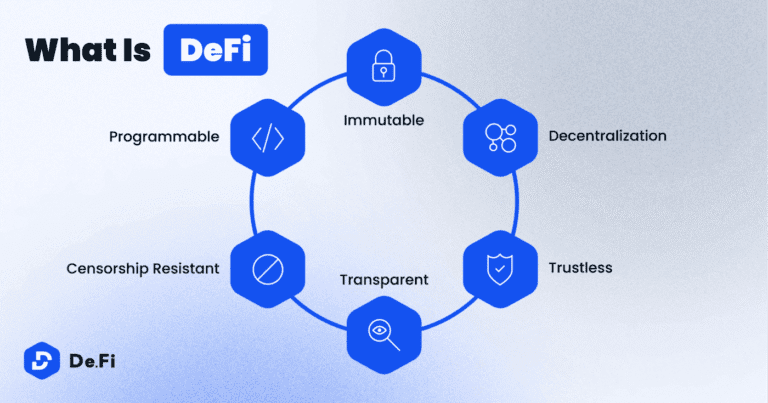
Key Features of DeFi
Understanding DeFi’s true nature means getting familiar with its basic pillars:
1. Decentralization
There’s no single company, government, or person controlling DeFi apps. Decisions about upgrades or policies are often made by user communities through governance tokens and voting.
2. Transparency
Since everything happens on public blockchains, you can literally see every transaction happening live. It’s like having a full ledger open to the entire world.
3. Permissionless Access
No “bank approval” required. Anyone with an internet connection and a crypto wallet (like MetaMask) can use DeFi apps. No nationality, income proof, or credit score barriers.
4. Non-custodial
You control your own assets. In traditional finance, your bank “holds” your money. In DeFi, your crypto wallet holds your funds directly—you own your private keys and control your money.
Core Components of DeFi
DeFi isn’t just one thing. It’s an ecosystem made of various services. Some of the key areas include:
- Decentralized Exchanges (DEXs):
Platforms like Uniswap and SushiSwap where people trade cryptocurrencies directly, without intermediaries. - Lending and Borrowing Platforms:
Protocols like Aave or Compound let you lend your crypto and earn interest, or borrow assets against your own holdings. - Stablecoins:
Cryptocurrencies like DAI that maintain a stable value, usually pegged to the US dollar, to counter crypto’s famous volatility. - Yield Farming:
Providing liquidity to DeFi platforms and earning rewards—often in the form of additional tokens. - Insurance:
Decentralized insurance platforms like Nexus Mutual offer coverage against things like smart contract failures. - Synthetic Assets:
Platforms like Synthetix create blockchain-based versions of real-world assets like gold, stocks, or currencies.
How Do Smart Contracts Work in DeFi?
Think of smart contracts as vending machines:
- You insert money.
- The machine checks the amount.
- If it matches the price, the product is automatically released.
Similarly, in DeFi:
- You lock your crypto into a smart contract.
- If conditions are met (like a loan repayment), the funds are released automatically.
No middleman. No back-and-forth paperwork. Just code, rules, and execution.
Advantages of DeFi
While DeFi isn’t magic, it does offer genuine benefits when done right:
- Global Access:
A user in a rural village with only a smartphone can access the same financial services as a Wall Street banker. - Financial Innovation:
Programmers can build new services without waiting for permission from regulators or gatekeepers. - User Empowerment:
Individuals control their own money, their own decisions, and even (through governance tokens) the future of the platforms they use.
Challenges and Limitations
DeFi isn’t without its flaws—and being honest about them is key:
- Security Risks:
Smart contracts can have bugs. If vulnerabilities exist, hackers can exploit them and drain funds. - Volatility:
Many DeFi platforms rely on volatile cryptocurrencies. Sharp price changes can lead to unexpected liquidations and losses. - Regulatory Uncertainty:
Governments around the world are still figuring out how to regulate DeFi, and future laws could affect how these platforms operate. - Complexity:
Using DeFi isn’t as easy as downloading a bank app. Users need to understand crypto wallets, gas fees, token swaps, and risks.
Is DeFi Here to Stay?
DeFi today is like the early internet of the 1990s: messy, exciting, full of potential but rough around the edges. Some projects will fail. Some experiments will vanish. But the core idea—that financial services can be decentralized, global, and open—is unlikely to disappear.
Whether DeFi completely replaces traditional finance or simply runs alongside it, it has already changed the way people think about money, trust, and innovation.
The next phase could be smoother user experiences, stronger regulations, and smarter integrations with traditional systems. Or it could be something no one has imagined yet—after all, that’s the nature of decentralized evolution.
Note: This article is based on factual, verified information publicly available as of April 2025. It is written for educational purposes, with no speculative content or financial advice.