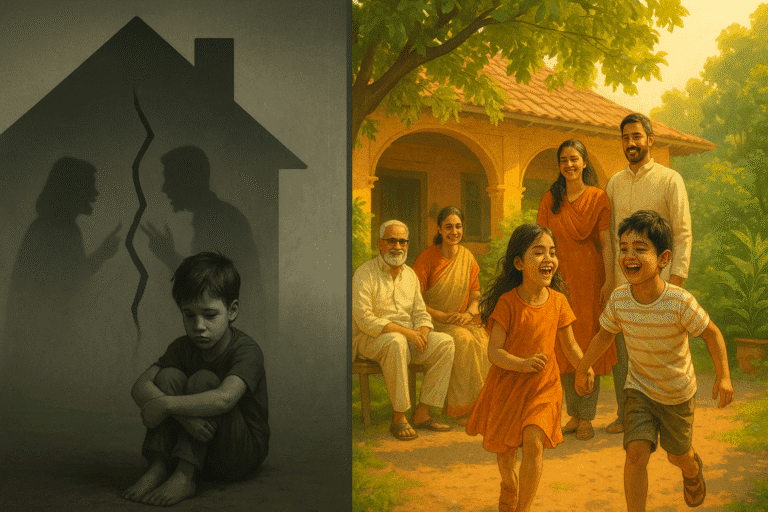
Imagine a world where every child’s laughter remains inviolable —ringing out free from the shadows of adult conflict—and playgrounds, not courtrooms, become the true arenas of youthful growth. Yet in much of Europe and North America, this vision falters: divorce rates have surged, support networks fragment, and overstressed parents unintentionally inflict an insidious atmosphere of fear and insecurity. India, drawing on its millennia-old tradition of collective caregiving and the ethos of Mātṛdevo Bhava (A Mother is Supreme God herself) and vasudhaiv kutumbakam (“the world is one family”), offers a compelling blueprint to protect childhood innocence and ameliorate the scars of broken, toxic, or abusive marriages.
The Western Marriage Challenge
- High Divorce Rates: In the United States, roughly 2.3 divorces occur per 1,000 inhabitants each year—translating to over 750,000 divorces annually and affecting nearly half of all children. In the European Union, the average divorce rate sits at 1.9 per 1,000, peaking above 2.5 in Belgium and Portugal.
- Rising Single-Parent Households: Today, about 24% of American families with children under 18 are headed by a single parent; across the EU, nearly 17% of households are single-parent, often stretching financial and emotional resources thin.
- Economic Strain: Single-parent families in Europe report child poverty rates up to 30% higher than two-parent homes, creating additional stressors that compound emotional distress.
The Hidden Toll on Children
Children caught in the crossfire of marital discord become the unseen victims:
- Emotional Trauma: A 2020 study in the Indian Journal of Psychiatry found that 42% of youngsters exposed to parental conflict display symptoms of anxiety, depression, or post-traumatic stress.
- Academic Setbacks: OECD research links family breakdowns to a 10–15% decline in standardized test performance, as distracted or overburdened parents struggle to support learning at home.
- Behavioral Risks: UNICEF’s 2021 Innocenti Report Card highlights that nations with higher divorce rates see increased adolescent risk-taking—early substance use, aggression, and involvement in juvenile delinquency.
- Social Isolation: Without extended kin to step in, many Western children face loneliness; the NSPCC reports that 30% of at-risk youths lack a reliable adult confidant outside their immediate household.
India’s Multi-Generational Advantage
Across India’s cities and villages, multi-generational living and community networks transform child-rearing from an isolated task into a shared mission:
- Round-the-Clock Guardianship: Grandparents, aunts, uncles, and cousins rotate caregiving duties, ensuring no child returns to an empty home after school.
- Cultural Anchor Points: Morning prayers, festival celebrations, and nightly storytelling circles reinforce moral values and a deep sense of belonging.
- Consistent Discipline: Even when one parent travels or works late, other family members maintain emotional continuity, providing stability amid marital tension.
- Emotional Mentorship: Elders impart life lessons through anecdotes, modelling resilience, empathy, and non-violent conflict resolution in ways that formal counselling often cannot replicate.
Measurable Impact of India’s Model
India’s collective caregiving yields tangible benefits:
- Rising Literacy: Youth literacy (ages 15–24) climbed from 86% in 2006 to 91% by 2018.
- Declining Juvenile Crime: The National Crime Records Bureau reports juvenile crime per 100,000 dropped from 3.9 in 2010 to 2.2 in 2020, despite rapid urbanization.
- Nutrition and Health: The Mid-Day Meal Scheme feeds over 120 million children daily, reducing absenteeism by 20% in participating schools and strengthening both concentration and emotional well-being.
Exporting India’s Blueprint Worldwide
Rather than supplant existing systems, India’s parenting model can complement and strengthen global frameworks:
- Multi-Generational Housing Incentives: Offer tax credits or subsidized loans for homes designed to host extended families under one roof.
- Community Care Hubs: Establish local centres where retirees and trained volunteers provide after-school mentoring, cultural activities, and safe spaces—mirroring India’s joint-family ethos.
- Parental Education Workshops: Require or subsidize classes on positive communication, conflict resolution, and emotional coaching, drawing on Indian philosophies of mutual respect.
- Enhanced Parental Leave: Advocate for a minimum of six months’ paid leave for both parents, recognizing the crucial importance of the first 1,000 days in a child’s life.
- Restorative Family Tribunals: Create legal venues focused on reconciliation and co-parenting solutions, avoiding adversarial court battles that exacerbate children’s stress.
Pilot programmes already validate this approach: Helsinki’s pairing of young families with retired mentors cut parental stress by 15%, while London’s “grandparent collectives” volunteering in schools have boosted both academic engagement and emotional resilience among participants.
Technology as a Bridge
Digital platforms can amplify and globalize India’s caregiving wisdom:
- Tele-Counselling Networks: AI-enhanced apps deliver real-time advice on emotional coaching, incorporating Indian proverbs and case studies from multi-generational homes.
- Virtual Storytelling: Interactive video sessions link Indian grandparents with children abroad, sharing folklore that teaches empathy and perseverance.
- Global Support Forums: Online communities moderated by experienced caregivers exchange daily tips on nurturing resilience, tempering Western individualism with India’s communal spirit.
Every Citizen’s Role
Safeguarding childhood innocence transcends policy—it demands collective vigilance. Teachers become early-warning sentinels for familial distress, healthcare providers screen for trauma during routine visits, and neighbours extend compassion when warning signs emerge. When one family falters, the broader community must rally under the banner of vasudhaiv kutumbakam, ensuring no child ever feels truly alone.
Picture a world where headlines celebrate youth-led peace initiatives instead of juvenile crime rates; where classrooms resonate with shared laughter rather than hushed whispers of despair; and where the doctrine of one global family becomes an everyday reality. By embracing India’s proven approach—rooted in shared responsibility, cultural anchoring, and emotional mentorship—we can heal the wounds of broken marriages and cultivate a generation unafraid to dream, explore, and thrive together as one worldwide family.