

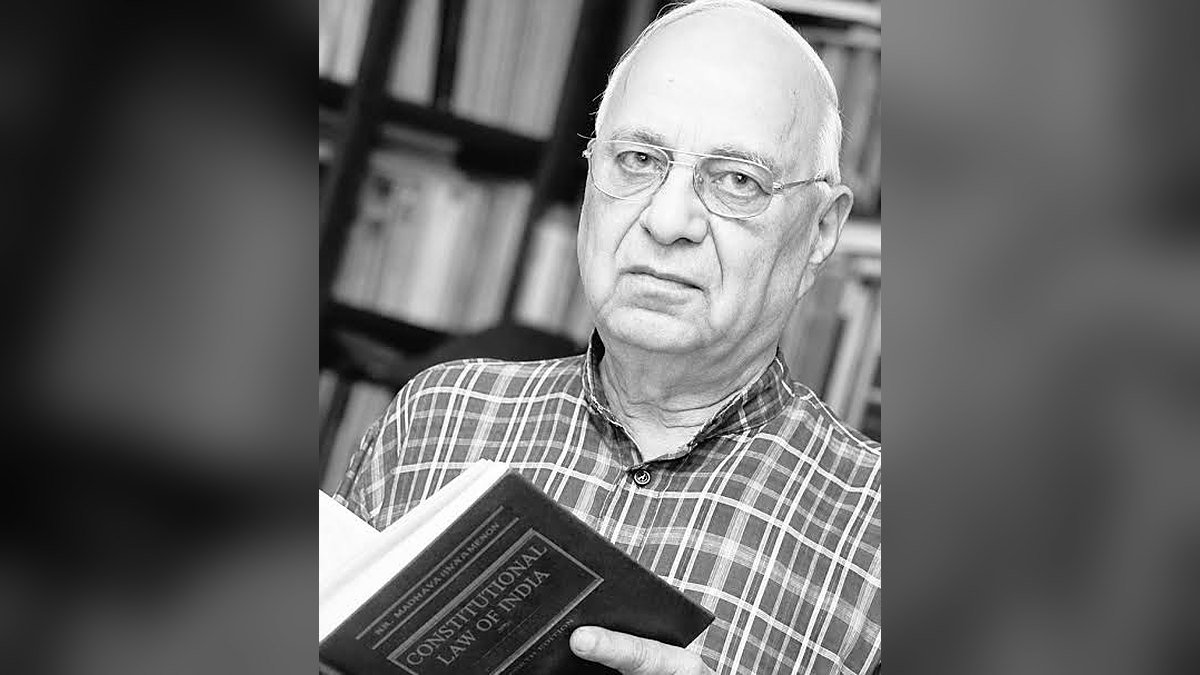
He never signed the document. He spent seven decades explaining it.
When the Constituent Assembly adopted the Constitution on 26 November 1949, Subhash Kashyap was 20 years old. He was not in the room. Yet few Indians did more in the decades after to make that text readable, usable and arguable by ordinary citizens. He died on 4 June 2026, aged 97.
Born in Chandpur, Bijnor, he began as a journalist, advocate and university teacher in Allahabad, then joined the Parliament Secretariat in 1953. Before taking the top job he headed the International Centre for Parliamentary Documentation at the Inter-Parliamentary Union in Geneva. He became Secretary-General of the Lok Sabha on 31 December 1983 and took voluntary retirement from the post in 1990. His tenure spanned the governments of Indira Gandhi, Rajiv Gandhi and V.P. Singh.
The Secretary-General serves the House and its Speaker, not any government, and must be right on procedure whoever is in power. That discipline runs through his writing. His six-volume History of the Parliament of India (1994–2000) became a standard reference. For general readers he wrote Our Parliament and Our Constitution for the National Book Trust. In all, he wrote more than 100 books. His 1969 study Politics of Defection examined floor-crossing in state politics years before Parliament legislated on it.
A working life after retirement
Retirement did not slow him down. He advised on Panchayati Raj laws and chaired the drafting committee of the National Commission to Review the Working of the Constitution. He later said he helped steer that body’s name toward reviewing the “working” of the Constitution, not the Constitution itself, because a constitution’s success, he held, depends on how it is worked. He also served on the high-level committee headed by former President Ram Nath Kovind on simultaneous elections.
A public voice on live questions
He noted that the Constitution never speaks of “Centre-state relations” and prefers “Union-state.” In 2016 he advised the Joint Parliamentary Committee on the Citizenship Amendment Bill not to name specific religious communities, warning of Article 14 concerns. In August 2019, as channels announced that Article 370 had been scrapped, he told ANI it had not been repealed and only parts of it had been removed. The Supreme Court unanimously upheld the abrogation in December 2023. Critics and supporters of each decision will read his comments differently, but his habit was constant: start from the text.
He received the Padma Bhushan in 2015. Lok Sabha Speaker Om Birla called him a “living encyclopedia” of the Constitution and Parliament.
On Samvidhan Divas, his legacy is a reminder that a constitution is only as strong as the public’s ability to read it.
Sources: Lok Sabha Secretariat and PTI/ANI reports on his death (4–5 June 2026); PIB Padma Awards 2015; The Statesman interview; The Quint (5 Aug 2019); Supreme Court judgment of 11 Dec 2023.

