Home Blog Page 3

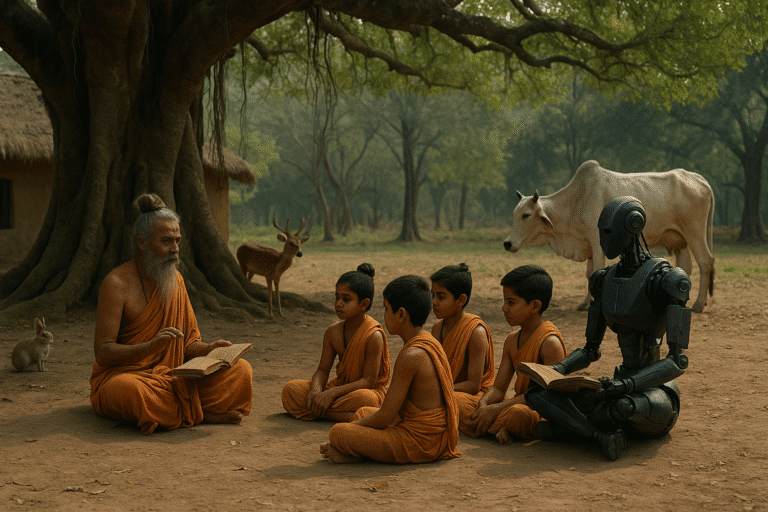
This AI powered Gurukul in NCR to train on Hardcore Mixed Martial Arts and Software development at early age to students.

Walk into any so-called Expensive world school, International school today, and you’ll find something deeply unsettling: children tired by 3 PM, restless by dinner, addicted to unhealthy snacks and Instagram secret groups, and emotionally detached from their roots. Bitter but true. Is this what our children deserve or is it just a Wealth created Trauma?

The Crisis in Our Classrooms

And worse—modern education has trained them to chase success, not meaning. To become consumers, not creators.

A shocking number of students—40% to 50% in some Elite urban schools—now suffer from early tooth decay, poor posture, attention deficits, and digital overstimulation. Many have never planted a tree. Few can read more than 10 pages without distraction.

In a time when childhood is increasingly absorbed by screen time, sugar-laced snacks, and soulless school routines, the International Shiva Tribe Foundation (ISTF) is sowing the seeds of a radical, yet anciently rooted idea: create the world’s most evolved individuals—through an education that balances Vedic wisdom, global competence, unparalleled physical strength, and emotional maturity.

This is not about reviving old traditions for nostalgia’s sake. It’s about rebuilding human potential at a time when society’s compass has gone astray. And that change begins at their emerging Gurukulam in Plikhuwa ( Delhi NCR)

Not JUST Another Gurukul. Aadya Katyayani Yogamaya Advaita Global Gurukulam by Shiva Tribe is A platform for attaining true overall abundance with world class education by teachers from 6 countries.

Set quietly amid India’s Capital Delhi NCR Region, Shiva Tribe’s Global Gurukulam is not a campus—it is envisioned as a karmabhoomi, where body, mind, and soul are trained to serve Sanatan Dharma and the world beyond with clarity and compassion.

Here, students won’t just memorize scriptures or practice rituals. They’ll live them, along with:
• Daily Mixed Martial Arts (MMA), Kalaripayattu, and warrior yogic practices
• A deep study of Vedas, Shastras, Vedic Mathematics, Modern science and carefully crafted curriculum of finest Global teachings and philosophy and deeply learning Indian family values.

• Finest collection of 5000+ books ranging from Vedas, Upanishads, Samhitas, Shastras, Adi Shankaracharya, Bruce Lee, Murakami, Voltaire, Heisenberg, Schrodinger and Endless Divine wisdom of this World to read instead of Instagramming their lives away to useless and harmful online content.
• Global learning: AI-powered research tools, multiple international languages, and practical life skills
• Financial wisdom rooted in dharma, not greed
• Book reading, memory cultivation, and mind-body balance

Its not just a Gurukul. As they say, they are on the mission to save the world, with grace.

This isn’t a utopia painted with idealism. It’s a well-thought blueprint to raise children who grow up with disciplined bodies, resilient hearts, and critical minds—like a Shaolin monk with a Silicon Valley brain and a Dharmic heart.

At ISTF Gurukul, the goal is different. They don’t just prepare students for exams—they prepare them for life.

The Return of the Warrior-Scholar. Every student is trained not just in academic knowledge, but in gau seva, dharma seva, emotional resilience, and physical vitality.

“When these students return home, they won’t just impress their families—they will transform them elevate them with love and respect,” one of the founders notes quietly.

These children would :
• Know how to care for their aging parents with joy, not obligation
• be able to spot nutritional deficiencies in a meal and fix them
• Understand ancient karmic philosophy and modern AI workflows
• Would rather read the Upanishads and Japanese philosophies than binge on reels

They are not rebels—they are reformers in the making.

What makes Shiva Tribe vision stand apart isn’t its ambition. It’s the understated integrity and need of the hour with which it’s being built.

Their founding team includes graduates from IITs, IIMs, and the University of Texas, yet there’s no noise around it. There’s no “corporate hero” campaign. Just a quiet, determined effort to create something civilizational in scale.

Just a flame of purpose. Real Roots. Not Buzzwords.

While the Gurukul remains the heartbeat of the ISTF, the foundation also aims to touch lives in other humble ways:
• A rural-to-global marketplace to connect organic pickles, handmade crafts, and sustainable goods with buyers across the world—curated not by trends, but by values
• A vision for regional plantation projects across the Himalayas, Gujarat, and Rajasthan—guided by bio-diversity and native ecosystem needs
• A commitment to only environmentally nourishing products, unlike the ocean of wasteful goods flooding today’s e-commerce portals

Even their much-admired Shiva Tribe Ghee, made from indigenous desi cows, is positioned not as a brand—but a symbol of purity from mother nature’s womb.

But these are accessories to the main revolution—the child.

What the World Needs Isn’t More Tech. It’s More Truth.

The ISTF Gurukul doesn’t reject modernity. It embraces it—with filters of wisdom. AI isn’t the enemy. But children using AI without dharma is a danger. Success isn’t the problem. It’s success without seva, compassion, or conscious consumption that creates emotional orphans.

This is where ISTF (Shiva Tribe) steps in: to recalibrate modernity using the oldest codes of life that Sanatana Dharma gave the world.

  • Imagine a generation that:
    • Writes code and recites shlokas
    • Practices Kung FU and keeps a calm mind like a shaolin monk.
  • Build LLM, Develop Generative Ai and Learn advanced Robotics for welfare of the planet.
  • ethical business leaders who interact with international clients and cows with equal ease.

No Grand Promises. Just a Living Path.

The International Shiva Tribe Foundation isn’t selling a fantasy. It’s building a future, step by step, breath by breath, child by child.

This isn’t a startup. It’s a soultap—a movement to reclaim the art of growing up, the Indian way, reimagined for a global tomorrow.

In their own words:

“We don’t want to raise students. We raise legends, who carry their ancestors in their spine and the future in their eyes.”

And if they succeed—even partly—it will be one of the greatest educational reforms of our time.

you can find out more about International Shiva Tribe -Foundation and its Social Initiatives on https://shivatribe.org/

Connect with shivam @9878096841 to Join Shiva Tribe NGO and help them achieve their goals.

India Needs a Work Culture Revolution — HAL Delays and the Cracks Across Our System- Air chief Marshal’s Fury

India stands at a powerful crossroad. A rising global economy, a tech-savvy youth population, and aspirations of becoming a global leader. Yet, despite all our progress, one glaring weakness holds us back: a systemic inertia across government departments and public-sector undertakings. The latest example? Air Chief Marshal Amar Preet Singh’s blunt criticism of Hindustan Aeronautics Limited (HAL) for delaying the delivery of Tejas Mk-1A fighter jets.

This is not just about HAL. It’s a warning bell for all of India.

Tejas Delay: Not Just a Defence Issue, But a Governance Red Flag

The Indian Air Force had expected HAL to deliver 83 Tejas jets on a tight schedule. These jets are critical for modernizing the force and reducing dependency on imports. But the delays have frustrated the IAF’s top brass.

Air Chief Marshal Singh, speaking with rare candor, stated:

“Timelines must be sacred. If we want to become Atmanirbhar (self-reliant), we must deliver, not just plan.”

His words cut through decades of bureaucratic comfort zones. When the highest-ranking officer of the Air Force speaks out publicly, it reveals a deeper rot. What if these delays had happened during a critical security situation? What if our soldiers are left unarmed due to organizational complacency?

This is not about jets. It’s about systemic failure.

The Larger Crisis: Broken Accountability in Government Work Culture

Across departments—be it the Railways, Municipal Corporations, Public Health, or even Judiciary—we see a pattern:

  • Projects that overshoot deadlines by years.
  • Housing schemes that fail to reach the right beneficiaries.
  • Clerks processing files at a snail’s pace.
  • Corruption going unchecked.

Verified Cases of Corruption and Neglect

  • The Adarsh Housing Scam: A housing society meant for war widows and heroes was taken over by politicians and bureaucrats.
  • The Fodder Scam: Billions siphoned from Bihar’s treasury meant for cattle fodder. A shameful mockery of governance.
  • Judicial Corruption Allegations: From allegations against judges to cash-for-verdicts controversies, even the judiciary hasn’t been immune.
  • Tej Bahadur Yadav’s Complaint: The BSF jawan publicly exposed the poor quality of food served to soldiers. Instead of fixing the issue, the system chose to remove him.

These cases show that inefficiency isn’t just about time delays; it’s about real human suffering.

BPO-Style Metrics: How AI Can Revolutionize Government Work

India’s BPO industry succeeded globally because of quantifiable targets, review dashboards, and real-time feedback systems. We can bring the same to our government system.

Here’s how:

  1. KPI-Based Assessment: Government employees must be assessed on file processing speed, citizen satisfaction, cost efficiency, and task completion rates.
  2. AI Dashboards: Every department should use AI-driven dashboards that show live project status, employee efficiency, and bottlenecks.
  3. Monthly Scorecards: Like in top BPO firms, issue monthly scorecards to every employee. High performers get rewarded. Slackers are retrained or reassigned.
  4. Public Ratings: Why not let citizens rate passport offices, municipal services, or railway cleanliness just like they rate Uber rides?
  5. Automation to Cut Corruption: AI bots can monitor procurement, construction contracts, and land deals—reducing human intervention and thus corruption.

World-Class Lifestyle for World-Class Service

But performance can’t come from pressure alone. We must inspire performance by respecting our employees, especially lower-grade staff.

Key Reforms:

  • Unified Housing Schemes: Remove the LIG, MIG, HIG divide. Grade 4 sanitation workers and officers alike deserve hygienic, well-maintained homes.
  • Top notch quality Education and Hygiene levels across all government schools: Quality school access ensures dignity and generational upliftment for all children of India and using AI based Ed-Tech for cost optimization.
  • Mental Health Support: Many lower-tier staff suffer silently. free Counseling, stress relief, and Yoga sessions must become the new normal. We want to be a truly developed country, right?

If we want a railway sweeper to keep stations spotless, we must ensure he returns to a clean home, not a slum. If we expect a clerk to serve with a smile, she must not be battling a healthcare crisis at home.

This is Not About HAL Alone

HAL’s delay should be the final straw. We should thank Air Chief Marshal Singh for his courage. His words must now lead to nationwide policy reform:

  • A central Government Performance & Wellness Commission (GPWC) must be created.
  • All departments must have live dashboards accessible to ministers, CMs, and the public.
  • AI-based monthly reviews must become the new norm.
  • Whistleblower protection must be reinforced with real safeguards.

India cannot become a superpower with 1990s governance systems. We can’t demand accountability without offering dignity. We can’t reward incompetence and hope for excellence.

The Final Word

“Don’t expect clean governance from a dirty system.”

We need a complete reset.

Let HAL be the turning point. Let Tejas be the spark. Let every government office—from the Panchayat to Parliament—be driven by performance, transparency, and respect.

Only then can India fly at the speed of her dreams.

Why #DeshdrohiDhoni Is Trending: Inside the Ugly Clash Between CSK and RCB Fan Armies

It started like most Twitter storms do—quietly, almost innocently. A comment on a cricket panel show, a few passionate replies, and then… a digital wildfire. But what made this different was the names involved: Mahendra Singh Dhoni and Virat Kohli, two of India’s greatest cricket icons. And the hashtags? Blazing with rage—#DeshdrohiDhoni and #NationalShameKohli. What the hell happened?

Let’s dive into this boiling pot of IPL 2025 fandom, ego, and unfiltered emotion.

The Trigger: One Line from Harbhajan Singh

Former cricketer Harbhajan Singh was casually giving his opinion on a live show:

“Dhoni ke fans asli hain. Baaki sab toh sirf social media ke paid likes hain.”

Translation? “Only Dhoni’s fans are real. The rest are just social media fluff.”

What might’ve seemed like a nostalgic nod to CSK’s iconic captain quickly detonated into something else entirely. Kohli fans took it as a direct insult, questioning the loyalty, emotion, and credibility of millions who have stood by King Kohli for over a decade.

#DeshdrohiDhoni Explodes: From Comment to Controversy

The phrase “Deshdrohi Dhoni” (Traitor Dhoni) wasn’t just harsh—it was shocking. Kohli supporters accused Dhoni of indirectly encouraging this narrative by not stepping in and condemning Harbhajan’s remark. They raked up old IPL controversies, criticized his post-retirement silence, and even questioned his nationalistic image.

The irony? Dhoni has never commented negatively about any player, let alone someone like Kohli, whom he’s praised multiple times. But in the age of social media, silence is often seen as consent.

The Counterpunch: #NationalShameKohli Trends

As expected, Dhoni fans didn’t sit quietly. They went to war.

The hashtag #NationalShameKohli surged within hours. The narrative? A rumored report that Kohli was planning to play for Middlesex in the English County circuit post-retirement. Dhoni fans labeled it “disloyalty to the soil,” dragging in terms like “foreign contract,” “brand over Bharat,” and “media darling turned deserter.”

No proof. No official confirmation. Just outrage on steroids.

IPL Fuel to the Fire: CSK vs RCB Narrative Reignites

Context is everything. And here’s what really lit the match:

  • RCB was on fire in IPL 2025. Top of the table, a playoff certainty.
  • CSK had just been eliminated, their playoff hopes crushed by Punjab Kings.
  • Kohli’s form was peak. Dhoni’s age was showing.

In the middle of that chaos, one comment about “real fans” touched every raw nerve in the book. It wasn’t just about cricket. It was about legacy.

The Psychology of Cricket Fandom in India

This wasn’t just a tweet war—it was a mass catharsis. In India, cricket isn’t just a sport, it’s a religion. And every religion has its sects, its holy books, and its prophets. Dhoni is the calm monk, the untouchable finisher. Kohli is the warrior king, all fire and fury. Their fanbases don’t just cheer—they believe.

So, when Harbhajan lit that matchstick, it was like questioning someone’s deity.

Facts, Fiction & Fanaticism: Where’s the Line?

Let’s look at the truth beneath the hashtags:

  • Harbhajan’s statement was personal opinion, not an official attack.
  • Dhoni hasn’t made a single public comment since the controversy erupted.
  • Kohli hasn’t responded either, choosing to let his bat speak.

Yet the fallout was real—millions of tweets, fan art burning, edited videos circulating false claims, and bots amplifying hate. All while the players themselves remained silent and graceful.

What It Says About Us: The Real Mirror

The real story isn’t Dhoni vs Kohli. It’s us vs ourselves.

Why are fans so easily divided? Why do we drag legends through digital mud? Why is criticism now equated with betrayal?

It’s worth noting that both players have shown public admiration for each other. Dhoni backed Kohli as captain. Kohli has called Dhoni his mentor. Their on-field chemistry, especially during high-pressure matches, has been celebrated. The hate is manufactured by us, not lived by them.

Let’s Not Forget: Both Are Sons of the Same Soil

Dhoni gave us the 2007 T20 World Cup and 2011 ODI World Cup.

Kohli brought in aggression, records, and Test domination overseas.

One gave us calm. The other gave us fire. Both gave everything.

And now, we trend hashtags calling them traitors?

This isn’t fandom. This is a societal wound—where hero-worship turns into hate the moment the narrative doesn’t suit our biases.

What Next? Rebuilding Respect in the Age of Virality

  • Let’s start with educating fanbases. Players are not gods. Nor are they demons.
  • Unverified news should be flagged, not forwarded.
  • Media panels should fact-check the impact of every statement, especially from ex-players.
  • And most importantly, we, as fans, must grow up.

Because if we don’t, we’ll lose more than matches. We’ll lose the very dignity that made Indian cricket respected worldwide.

Final Thought (not a cliché conclusion)

#DeshdrohiDhoni isn’t a trending tag. It’s a wake-up call.

And if we don’t hear it now, we’ll keep burning the very legends we once built temples for.

Cut, Heal, Repeat: The Rise of Self-Repairing Robots in 2025

0

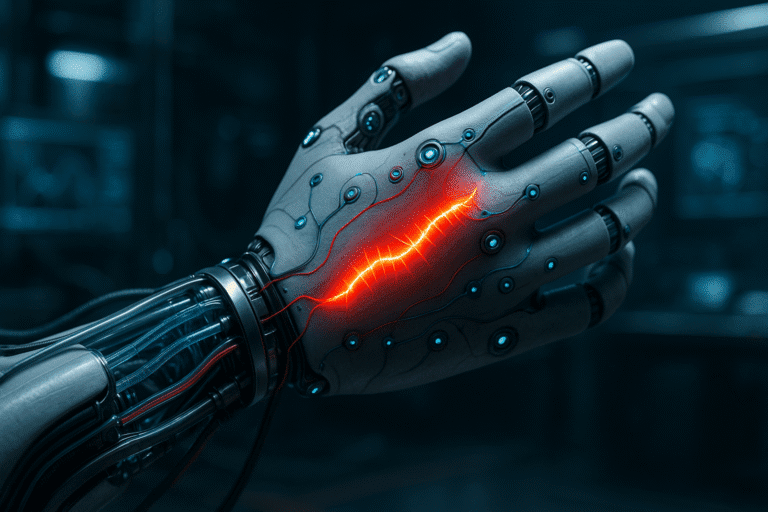
Engines whirr, soft polymers stretch and mend, and tiny sensors hum as they detect tears in real time. Welcome to the brave new world of self-healing robotics in 2025—machines that don’t just withstand damage, they recover from it, all on their own. As someone who’s watched the slow march from proof-of-concept polymer grippers to integrated healing systems, I’m struck by how far we’ve come. In labs around the globe, researchers are stitching together materials science, biology, microfluidics and AI to build robots that bounce back from punctures, cuts and even structural failures—without a human lifeline.

From 2017’s Polymer Pioneers to Today’s Smart Materials

Back in 2017, a team at Vrije Universiteit Brussel showcased soft grippers made of Diels–Alder polymers that could heal when gently heated. That demonstration proved the concept: reversible covalent bonds could unzip and reseal, restoring strength. Fast-forward to 2025, and those same principles have evolved into room-temperature systems. By blending supramolecular interactions—hydrogen bonds, metal coordination—with dynamic polymer networks, modern elastomers no longer need external heat. They respond to ambient triggers like humidity or light, flowing into cracks and reknitting themselves. From my vantage point, this leap feels akin to moving from black-and-white sketches of life to full-color animation.

Next-Gen Self-Healing Materials

Today’s robots are wrapped in multifunctional skins that heal on demand:

  • Stimuli-Responsive Polymers now operate at body temperature, using reversible ionic bonds to slip past one another and rebind seamlessly.
  • Microvascular Networks embed tiny channels carrying healing agents—monomer blends that polymerize upon contact with a catalyst released at the damage site.
  • Supramolecular Gels rely on non-covalent interactions to snap back into place, mending tears in seconds.

These materials aren’t just tougher—they’re smarter, integrating sensors that monitor their own integrity.

Sensing Damage with AI-Driven Precision

Detecting a puncture is only half the battle—localizing and diagnosing it is where artificial intelligence shines. Flexible sensors woven into soft bodies use piezoresistive and optical‐fiber networks to map strain changes with sub-millimeter accuracy. Machine-learning models trained on thousands of damage scenarios can distinguish a clean cut from a crush or abrasion, then recommend the optimal healing route. From my discussions with colleagues, the consensus is clear: without these intelligent eyes and ears, self-healing remains reactive and slow. Now, robots know exactly what went wrong and when, kick-starting repairs the instant damage occurs.

The Rise of Bio-Hybrid Self-Repair

Injecting a living dimension, bio-hybrid robots blend muscle cells and synthetic scaffolds:

  • Cardiac-Muscle Actuators contract like real tissue and regenerate through cell proliferation.
  • Vascularized Scaffolds sustain embedded cells via microfluidic capillaries, enabling genuine tissue repair.
  • Living Sensor Networks use neuron-like cells to reroute signals around damaged zones, maintaining function while biological processes kick in.

This fusion of biology and mechanics means repairs can unfold over hours or days, with robots that literally grow back missing sections.

Embodied Intelligence & On-Board Repair Tools

Healing isn’t just about smart materials—it’s about having the right tools built in. Modern prototypes carry miniature heating elements, pH-sensitive valves and deployable micro-needles that “stitch” polymer threads across rips. Microfluidic circuits pump healing electrofluids—liquid precursors that cure into flexible, adhesive films—directly into damage pockets. In higher-end models, tiny robotic arms weave new polymer filaments into the matrix. The result? A fully integrated workflow: sense, clean, close, cure and test, all without human intervention.

Flagship Projects Pushing Boundaries

Several ambitious initiatives have demonstrated near-complete autonomy:

  • EU’s SHERO Project fuses self-healing elastomers, distributed sensors and AI control loops into a single soft robot that can sense a cut, route healing agents, activate micro-heaters and verify strength—all within minutes.
  • NASA’s SoftBot Pathfinder (2024) tested self-repairing arms on simulated lunar surfaces, showing resilience to rock impacts and temperature swings.
  • MIT’s BioMech Lab cultivated living skins that regenerate micro-tears through embedded stem-cell reservoirs, closing gaps in soft actuators over successive days.

Each prototype edges us closer to robots that really do look after themselves.

Real-World Applications Driving Innovation

Self-healing robots are no longer sci-fi curiosities—they’re solving pressing challenges:

  • Space Exploration: Maintenance-free probes and habitat walls endure micrometeoroid impacts without repair crews.
  • Deep-Sea Missions: Submersibles operating at pressure margins bounce back from contact with rocks or coral.
  • Medical Devices: Soft catheter bots seal micro-perforations autonomously, reducing infection risk and extending device lifespans.
  • Manufacturing Lines: Robotic grippers self-repair after repeated abrasion, slashing downtime.

This resilience not only cuts costs but unlocks missions in unreachable or hazardous environments.

Challenges and Ethical Considerations

Despite thrilling advances, hurdles remain. Healing systems add complexity, weight and energy demands—designers must balance resilience with efficiency. Biological components raise questions about containment, ethics and long-term viability: how do we regulate robots that contain living tissue? Security experts warn that self-repairing military drones could complicate disarmament treaties. From my conversations with ethicists, transparency and robust oversight are critical. We must ensure that robots heal responsibly, without unintended consequences to environments or societies.

Peering Ahead: Toward Fully Autonomous Guardians

Looking to 2030 and beyond, I’m convinced we’ll see robots that heal faster than we blink: materials that reconfigure in milliseconds, self-assembling micro-robots that rebuild entire sections, and AI brains that predict damage before it happens. We’re on the cusp of a paradigm where machines don’t just resist harm—they thrive on challenge, emerging stronger after every test. As these resilient companions move from labs into our skies, seas and hospitals, they’ll redefine our expectations for what technology can do—and perhaps teach us a thing or two about recovery, resilience and the art of bouncing back.

what mental horrors an OnlyFans creator’s parents have to go through

Before, i begin to write this, my heart breaks to see what materialism has done to our society and its innocent souls.

Imagine how it feels for a mother who once nursing her child at dawn, fought the world to raise her, only to see that same daughter turn away when she speaks. Generations of love and sacrifice give way to a new social script urging “follow the money”—a conditioning that whispers making fast cash is more important than preserving one’s dignity. That wrenching moment, when a mother realizes her child values fleeting online applause over the steadfast wisdom of family, marks the true beginning of this crisis.

When a parent first learns that their child has become an OnlyFans creator, the ground seems to shift beneath their feet. One moment, family dinners and weekend plans felt effortless; the next, they’re plunged into a private storm of fear, shame, and relentless self-doubt. Sleepless nights follow, marked by a compulsive urge to check social-media feeds and a simultaneous dread of what more they might discover. In that fragile space between denial and acceptance, parents must marshal every ounce of their emotional strength—even as every instinct tells them to flee.

1. The Thunderclap of Shock and Denial
Discovery often strikes without warning: a late-night message from a friend, an accidental notification, or a glimpse of unfamiliar content. In those first hours, disbelief and urgency collide. Minds race with questions—“How did we miss the signs?” “Is this just a phase?”—while hearts pound with the fierce need to protect. If unchecked, this acute stress can seed chronic anxiety, making it nearly impossible to find emotional balance.

2. Whispered Judgments and Silent Isolation
As news spreads, invitations vanish and once-friendly neighbors grow distant. Casual greetings morph into loaded encounters, fraught with unspoken disapproval. Many parents withdraw into self-imposed exile, believing solitude will shield them from shame. Yet this silence only magnifies their loneliness, turning quiet evenings into echo chambers of regret. True connection—though briefly severed—remains the lifeline they most desperately need.

3. The Crushing Weight of Guilt and Self-Reproach
In the quiet hours before dawn, parents replay memories—birthday parties, school recitals, bedtime stories—each one tinged with a question: “What could I have done differently?” This relentless self-blame corrodes confidence and transforms daily routines into reminders of perceived failure. Without compassionate support or self-reflection, this guilt can spiral into depression, making even the smallest acts of self-care feel impossible.

4. Financial Fears and the Scars of Secondary Trauma
Alongside emotional turmoil comes a visceral fear of predation: slick “managers” promising fame, blackmailers threatening exposure. Every late-night call—whether a distressed child or an ominous demand—triggers a fight-or-flight response, keeping parents perpetually on edge. As they learn of manipulative subscribers or exploitative schemes, they often experience secondary trauma: panic attacks, tension headaches, and a pervasive sense of vulnerability that mirrors direct harm.

5. Fractured Bonds and the Allure of Over-Protection
Shame chokes off honest conversation, leaving siblings feeling overlooked and homes transformed into minefields of awkward silences. In desperation, some parents resort to strict monitoring—curfews, social-media tracking, even reading private messages—believing control will restore safety. Instead, these measures often backfire, pushing the creator deeper into secrecy and widening the gulf of mistrust.

6. Seeking Solace: Therapy, Community, and Rituals
Hope often emerges when parents admit they cannot face this alone. Trauma-informed therapists provide tools to untangle guilt and rebuild self-worth, while family counseling opens the door to hesitant truths and tentative reconciliation. Peer-led support groups—both online and local—offer practical advice and the vital reminder that no one endures this struggle in isolation. Simple rituals, such as weekly device-free dinners or brief check-ins over coffee, slowly rekindle honest communication and shared presence.

7. The Philosophical Bridge: Parents as the Last Thread of Hope
In life’s grand tapestry, the parent–child bond is woven from the strongest fibers of love, history, and shared memory. Even when that bond frays under the weight of shame, it need not break. To abandon a child at her lowest ebb is to sever the final path to renewal. By remaining present—listening without judgment and affirming worth beyond any digital persona—parents become the living bridge that guides their child from toxic attention-seeking back to genuine self-respect, purpose, and the promise of a brighter tomorrow.

At its heart, this journey is more than crisis management; it is a profound lesson in unconditional love. Parents, you are the keepers of your child’s earliest dreams and deepest truths. Though the storm of confusion and despair may rage fiercely, remember that your unwavering presence is the single greatest force of hope they will ever know. By refusing to turn away—by offering compassion when it is hardest to feel—you do more than support their healing: you light the way for them to discover their true potential, far beyond the fleeting lure of digital approval.

8. Final Plea: Never Abandon the Only Hope
Above all, parents must remember that they remain their child’s single strongest lifeline. Even when shame and fear tempt them to turn away, abandoning a child at her lowest is the surest way to sever her last bridge back to safety and self-worth. Instead, hold fast to hope—believe that one day she will see beyond the lure of material approval, recognize the enduring strength of familial love, and return to the arms that first held her. Your unwavering presence and compassion can guide her out of the trap of toxic attention-seeking and back into the warmth of home.

9. A Global Call to Action
Beyond its personal toll, OnlyFans represents a societal rupture that demands international intervention. When millions of young people are conditioned to equate self-worth with fleeting digital approval, we erode the very fabric of an already fragile generation. The United Nations—charged with upholding human dignity—and governments across the world must recognize this platform for the exploitative force it has become. By instituting a ban or stringent regulations, policymakers can reclaim the narrative from toxic attention-seeking and protect vulnerable individuals from a marketplace that trades in their self-respect. Such decisive action isn’t censorship; it is a moral imperative to safeguard mental health, restore the value of authentic human connection, and uphold the dignity of future generations.

Let’s all of us have faith in ShivaShakti, a pot full of evil will spill out and this society will go back to 17th century with no internet, no electricity one day and everything will start to function once again like the good old days. More love to every divinity that’s on onlyfans and may god give wisdom to all those onlyfans subscriber men out there one day to start respecting women and not reflect their devilish ego by paying money to see someone’s daughter on a cringe, devil website, that’s destroying millions of families. Respect above sensory pleasure.

From Shadows to Sunlight: India’s Collective Parenting Blueprint for Safeguarding Childhood & Innocence

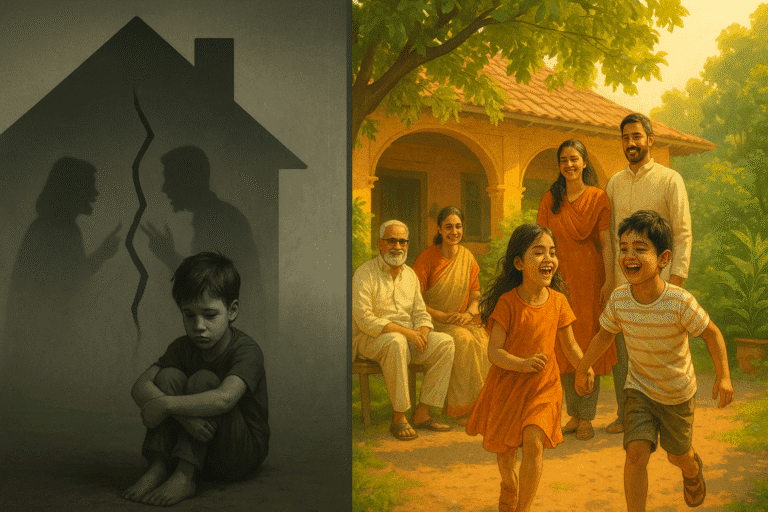
Imagine a world where every child’s laughter remains inviolable —ringing out free from the shadows of adult conflict—and playgrounds, not courtrooms, become the true arenas of youthful growth. Yet in much of Europe and North America, this vision falters: divorce rates have surged, support networks fragment, and overstressed parents unintentionally inflict an insidious atmosphere of fear and insecurity. India, drawing on its millennia-old tradition of collective caregiving and the ethos of Mātṛdevo Bhava (A Mother is Supreme God herself) and vasudhaiv kutumbakam (“the world is one family”), offers a compelling blueprint to protect childhood innocence and ameliorate the scars of broken, toxic, or abusive marriages.

The Western Marriage Challenge

  • High Divorce Rates: In the United States, roughly 2.3 divorces occur per 1,000 inhabitants each year—translating to over 750,000 divorces annually and affecting nearly half of all children. In the European Union, the average divorce rate sits at 1.9 per 1,000, peaking above 2.5 in Belgium and Portugal.
  • Rising Single-Parent Households: Today, about 24% of American families with children under 18 are headed by a single parent; across the EU, nearly 17% of households are single-parent, often stretching financial and emotional resources thin.
  • Economic Strain: Single-parent families in Europe report child poverty rates up to 30% higher than two-parent homes, creating additional stressors that compound emotional distress.

The Hidden Toll on Children

Children caught in the crossfire of marital discord become the unseen victims:

  1. Emotional Trauma: A 2020 study in the Indian Journal of Psychiatry found that 42% of youngsters exposed to parental conflict display symptoms of anxiety, depression, or post-traumatic stress.
  2. Academic Setbacks: OECD research links family breakdowns to a 10–15% decline in standardized test performance, as distracted or overburdened parents struggle to support learning at home.
  3. Behavioral Risks: UNICEF’s 2021 Innocenti Report Card highlights that nations with higher divorce rates see increased adolescent risk-taking—early substance use, aggression, and involvement in juvenile delinquency.
  4. Social Isolation: Without extended kin to step in, many Western children face loneliness; the NSPCC reports that 30% of at-risk youths lack a reliable adult confidant outside their immediate household.

India’s Multi-Generational Advantage

Across India’s cities and villages, multi-generational living and community networks transform child-rearing from an isolated task into a shared mission:

  • Round-the-Clock Guardianship: Grandparents, aunts, uncles, and cousins rotate caregiving duties, ensuring no child returns to an empty home after school.
  • Cultural Anchor Points: Morning prayers, festival celebrations, and nightly storytelling circles reinforce moral values and a deep sense of belonging.
  • Consistent Discipline: Even when one parent travels or works late, other family members maintain emotional continuity, providing stability amid marital tension.
  • Emotional Mentorship: Elders impart life lessons through anecdotes, modelling resilience, empathy, and non-violent conflict resolution in ways that formal counselling often cannot replicate.

Measurable Impact of India’s Model

India’s collective caregiving yields tangible benefits:

  • Rising Literacy: Youth literacy (ages 15–24) climbed from 86% in 2006 to 91% by 2018.
  • Declining Juvenile Crime: The National Crime Records Bureau reports juvenile crime per 100,000 dropped from 3.9 in 2010 to 2.2 in 2020, despite rapid urbanization.
  • Nutrition and Health: The Mid-Day Meal Scheme feeds over 120 million children daily, reducing absenteeism by 20% in participating schools and strengthening both concentration and emotional well-being.

Exporting India’s Blueprint Worldwide

Rather than supplant existing systems, India’s parenting model can complement and strengthen global frameworks:

  1. Multi-Generational Housing Incentives: Offer tax credits or subsidized loans for homes designed to host extended families under one roof.
  2. Community Care Hubs: Establish local centres where retirees and trained volunteers provide after-school mentoring, cultural activities, and safe spaces—mirroring India’s joint-family ethos.
  3. Parental Education Workshops: Require or subsidize classes on positive communication, conflict resolution, and emotional coaching, drawing on Indian philosophies of mutual respect.
  4. Enhanced Parental Leave: Advocate for a minimum of six months’ paid leave for both parents, recognizing the crucial importance of the first 1,000 days in a child’s life.
  5. Restorative Family Tribunals: Create legal venues focused on reconciliation and co-parenting solutions, avoiding adversarial court battles that exacerbate children’s stress.

Pilot programmes already validate this approach: Helsinki’s pairing of young families with retired mentors cut parental stress by 15%, while London’s “grandparent collectives” volunteering in schools have boosted both academic engagement and emotional resilience among participants.

Technology as a Bridge

Digital platforms can amplify and globalize India’s caregiving wisdom:

  • Tele-Counselling Networks: AI-enhanced apps deliver real-time advice on emotional coaching, incorporating Indian proverbs and case studies from multi-generational homes.
  • Virtual Storytelling: Interactive video sessions link Indian grandparents with children abroad, sharing folklore that teaches empathy and perseverance.
  • Global Support Forums: Online communities moderated by experienced caregivers exchange daily tips on nurturing resilience, tempering Western individualism with India’s communal spirit.

Every Citizen’s Role

Safeguarding childhood innocence transcends policy—it demands collective vigilance. Teachers become early-warning sentinels for familial distress, healthcare providers screen for trauma during routine visits, and neighbours extend compassion when warning signs emerge. When one family falters, the broader community must rally under the banner of vasudhaiv kutumbakam, ensuring no child ever feels truly alone.

Picture a world where headlines celebrate youth-led peace initiatives instead of juvenile crime rates; where classrooms resonate with shared laughter rather than hushed whispers of despair; and where the doctrine of one global family becomes an everyday reality. By embracing India’s proven approach—rooted in shared responsibility, cultural anchoring, and emotional mentorship—we can heal the wounds of broken marriages and cultivate a generation unafraid to dream, explore, and thrive together as one worldwide family.

When Enlightenment Embraced the East: Voltaire’s Ode to India’s Ancient Wisdom

Imagine a pillar of the French Enlightenment—Voltaire—celebrated across Europe as a brilliant satirist, fearless critic of superstition, and tireless advocate for reason. Born François-Marie Arouet in 1694, he grew to challenge absolute monarchy, lampooning bishops and tyrants alike in works such as Candide and Letters on England. Voltaire’s pen sparked revolutions of thought, reshaping politics, religion, and philosophy across the continent.

In an astonishing gesture of cross-cultural admiration, Voltaire praised the ancient Vedas—India’s foundational scriptures—as “the most precious gift for which the West had ever been indebted to the East.” That tribute still resonates in modern India, reminding us that our millennia-old heritage profoundly influenced Western Enlightenment ideals. His reverence for Bharata’s wisdom offers India both national pride and a model of universal humanism.


Deist Foundations and Universal Brotherhood

Voltaire embraced a form of faith known as deism, believing that human reason alone sufficed to recognize a single, all-powerful Creator, without the need for miracles or revelations. He argued that belief based on logic and observation of the natural world was cleaner and more just than dogma dictated by any church . In his landmark essay A Treatise on Toleration (1763), he famously asserted: “All men are brothers,” sweeping aside religious divisions to call for compassion and coexistence. This vision of universal brotherhood would resonate in pluralistic India centuries later, where diversity of faiths lives side by side.

Deism also fueled Voltaire’s critique of clergy and superstition. He took aim at corrupt institutions, declaring that people should never sacrifice justice for blind devotion. His belief that reason could reveal divine order led him to defend civil liberties and champion the idea that no government or church should wield unchecked power over the conscience. This Enlightenment spirit—skeptical of revealed religion yet open to moral truths—mirrors India’s own tradition of philosophical inquiry, where questioning and debate have been valued since the days of the Upanishads.

Applauding the Vedas: Antiquity and Moral Authority

Voltaire’s statement that “The Veda was the most precious gift for which the West had ever been indebted to the East” signaled profound respect for Indian thought . In Europe, where medieval scholasticism still held sway, this remarkable endorsement cast Sanskrit scriptures as timeless sources of ethical and metaphysical insight. He contrasted the Vedic vision of a harmonious universe—governed by dharma, or cosmic order—with a Europe fractured by sectarian violence and power struggles.

His admiration stemmed not merely from the texts’ age but from their teachings on duty, morality, and the unity of all existence. Voltaire viewed the Vedas as evidence that ancient Indians had grappled with questions of right action and the nature of reality long before the rise of Greek philosophy. By elevating these ideas in his writings, he encouraged European intellectuals to broaden their sources and acknowledge that wisdom had flourished beyond Western shores. This recognition laid early groundwork for Orientalist scholarship and opened a window to intercultural exchange.

Ethics of Nonviolence and Animal Rights

Voltaire’s respect for Vedic principles extended into his personal life: moved by notions of ahimsa, he adopted vegetarian practices and advocated for kindness to all living beings. In his letters, he described Hindu communities as models of gentle society—“peaceful and innocent people” who revered cows and spared sentient creatures from harm. He used this example to shame European aristocrats and traders whose fortunes often stained their hands with blood.

His writings helped seed the idea that compassion should extend beyond human society. Though the animal welfare movement in Europe would only coalesce in the 19th century, Voltaire’s early defenses of animal rights echoed principles deeply rooted in India’s spiritual traditions. Today, India’s robust animal protection laws and widespread vegetarianism reflect a cultural continuity that Voltaire first spotlighted for Western audiences.

Origins of Science: From the Ganges to Greece

In a 1775 letter to the astronomer Jean-Sylvain Bailly, Voltaire daringly speculated that disciplines such as astronomy, geometry, and metaphysics traced their lineage to scholars on the banks of the Ganges. He quipped that Pythagoras himself journeyed from Samos to India in search of geometric truths. While modern historians debate the literal accuracy of this account, the very suggestion reframed India not as a peripheral land but as a cradle of intellectual breakthroughs.

This theory challenged the prevailing Eurocentric narrative that positioned Greece as the singular birthplace of Western science. By mapping a shared genealogy of ideas, Voltaire underscored the unity of human inquiry across continents. His approach inspired later generations of Orientalists and Indologists to delve into Sanskrit manuscripts, translating works on mathematics, astronomy, and medicine that would enrich European libraries and universities in the 19th century.

Echoes of Advaita Vedānta

Although Voltaire never studied Sanskrit or Advaita Vedānta texts directly, his monistic deism bears striking resemblance to the Advaitic teaching that the individual self (Ātman) and ultimate reality (Brahman) are one. He rejected the notion of multiple gods with competing wills, instead affirming a single divine essence revealed through nature’s order. In this sense, his philosophy met Vedāntic insights at a crossroads of rational inquiry and mystical unity.

Both deism and Advaita emphasize an ethical life grounded in awareness of an underlying oneness. Voltaire’s belief in tolerance and universal morality aligns with the Vedāntic view that egoistic divisions are illusory (maya), and that recognition of shared divinity leads to compassion. This conceptual overlap—transcending rituals and sectarian rites—offered an implicit bridge between Western Enlightenment and Eastern spiritual traditions.

Legacy: A Bridge Between East and West

Voltaire’s selective yet heartfelt engagement with Indic traditions catalyzed the early wave of Orientalist scholarship, compelling Europeans to appreciate India’s philosophical and scientific heritage. By championing the Vedas and positing Indian origins for key disciplines, he broadened the intellectual horizons of his contemporaries and planted seeds for future intercultural dialogue.

In modern India, Voltaire’s declarations are often cited with pride: a Western luminary recognizing the brilliance of Bharata’s sages lends fresh admiration for our roots. His writings remind us that wisdom transcends borders and that ancient texts still have the power to illuminate our present challenges—from ethical governance and religious tolerance to environmental stewardship and scientific cooperation.

As we revisit Voltaire’s fascinating embrace of Indian thought, we celebrate not only his legacy as an Enlightenment giant but also the enduring relevance of the Vedas, Advaita Vedānta, and the spirit of universal humanism they inspire.

Babiya the Vegetarian Crocodile: How Temple Prasadam and Devotion Fueled a 75-Year Miracle

Humility, wonder, and reverence converge on the banks of a temple tank in Kasaragod, Kerala, where for over seven decades a crocodile named Babiya defied nature’s norms. In a world where carnivores are bound by instinct, Babiya subsisted entirely on temple prasadam—sacred rice and jaggery offerings—embodying a rare fusion of devotion and biology that propelled her into legend (www.ndtv.com). Her story invites us to explore how an unshakable bond with the divine can manifest in astonishing ways, granting the fiercest of beasts a life of harmonious contentment.

Babiya’s life began as a mystery. Local lore recalls that in 1945, a new “divine” crocodile appeared in the Ananthapura Lake Temple—reputedly the original seat (moolasthanam) of Lord Ananthapadmanabha—and never left its waters . Worshippers embraced her as a living guardian, feeding her twice daily with freshly prepared prasadam after puja rituals. Legends of Gajendra Moksha (the liberation of an elephant king by Lord Vishnu) found new expression in Babiya’s calm presence, as she roamed near devotees without aggression, a living symbol of divine compassion

Despite her aquatic domain teeming with fish, temple custodians steadfastly prepared vegetarian offerings for Babiya. Twice each day, priests set aside portions of cooked rice and jaggery, believing that her spiritual purity would render carnivory unnecessary. Over time, Babiya’s acceptance of only prasadam became an anachronistic (out of sync with natural history) marvel that drew pilgrims from across India, all seeking to witness this singular testament to faith and nature intertwined

Science, however, remained skeptical. Ramachandran Bhat, the temple secretary, acknowledged that the lake housed fish and that Babiya may have supplemented her diet despite popular belief. Yet even if she consumed occasional fish, her remarkable longevity—living 75–80 years, roughly double the lifespan of wild crocodiles—underscores a life far healthier and more robust than typical captive reptiles (The Economic Times). This paradox challenges our assumptions about animal physiology and suggests that the ubiquitous (found everywhere) provision of high-quality temple offerings conferred unexpected nutritional and psychological benefits.

Devotees saw in Babiya’s gentle demeanor the fruits of constant spiritual nourishment. In Hindu thought, prasadam is more than food—it is sanctified grace, imbued with divine presence. Feeding Babiya became an act of sādhanā (spiritual practice), reinforcing the conviction that her devotional bond with the deity sustained her life. Witnessing a creature so potent choose non-violence inspired countless pilgrims to reflect on their own dietary and ethical choices, transforming a routine offering into a profound statement of non-harm (ahimsa) .

When Babiya’s body was found floating in the lake on October 9, 2022, grief swept through Kerala. Hundreds gathered for her funeral procession, adorning her carcass with flowers, carrying it on a coconut-leaf litter, and burying her within temple grounds as if honoring a saint . Union Minister Shobha Karandlaje tweeted that the “God’s own crocodile” had attained sadgati (salvation), highlighting how Babiya’s end resonated as a spiritual event rather than mere wildlife news

Beyond its emotional resonance, Babiya’s story prompts scientific inquiry. How did a crocodile thrive on a vegetarian diet lacking taurine, arachidonic acid, and other nutrients typically essential for carnivores? Researchers speculate that occasional fish consumption or the exceptional nutritional density of temple prasadam may have filled critical gaps. Still, no systematic study has resolved this enigma, leaving Babiya as an enduring subject for investigations into animal adaptation and the psychosomatic effects of ritual feeding

In November 2023, a smaller crocodile surfaced in the same lake, drawing fresh crowds convinced it was Babiya’s spiritual successor. It, too, seemed to exhibit peaceful behavior, shunning fish and content with prasadam—an echo of the devotion-nourished equilibrium Babiya once demonstrated . Whether this newcomer truly follows in her footsteps or simply benefits from an environment steeped in sacred feeding rituals, the cycle of belief and wonder continues.

At its core, Babiya’s tale reminds us that concord (harmony) between humans, animals, and the divine can yield outcomes that transcend conventional wisdom. Her life on prasadam was more than a dietary anomaly; it was a living parable of how spiritual connectivity can foster well-being across species. Whether one interprets her longevity as a miracle or a case study in adaptive behavior, Babiya stands as a testament to the extraordinary possibilities unlocked when faith and biology converge.

As pilgrims still flock to Ananthapura Lake Temple, they come not merely to pay homage to a departed crocodile, but to partake in a legacy of devotion that nourished the heart of an apex predator. In that sacred pond, faith became sustenance, and Babiya—a creature of primordial strength—became an emblem of peace. This is a rarefied chapter in nature’s chronicle, where a crocodile’s life on vegetarian prasadam paralleled humanity’s quest for deeper meaning and compassionate coexistence.

“Why Non-Vegetarian Diets No Longer Make Sense: The Science Behind Plant-Powered Health & Performance”

0

Humans stand at a crossroads where our dietary choices reverberate through health, environment, and ethics. Wave after wave of research has identified poor diet as a leading cause of premature death, with dietary and lifestyle changes urgently needed to curb this trend . In recent years, “The Game Changers” documentary awakened millions to the possibility that plant-powered nutrition can unlock new levels of human performance, a phenomenon dubbed the “Game Changers effect” . As we grapple with rising chronic diseases and ecological crises, it’s time to question whether non-vegetarian diets truly serve our highest potential—or simply bind us to outdated paradigms.

Health: From Disease Risk to Vitality

A wealth of clinical studies shows that diets rich in animal products correlate strongly with cardiovascular disease, certain cancers, and type 2 diabetes. “The Game Changers” emphasizes how plant-based diets promote heart health, decrease systemic inflammation, and lower cancer risk while enhancing physical performance . One landmark modeling study in PNAS estimated that widespread vegan adoption could prevent over 8 million deaths by 2050, while a vegetarian shift could avert loss of 7.3 million lives, saving trillions in healthcare costs (Time). By contrast, diets heavy in red and processed meats remain among the top dietary killers globally, underscoring why non-vegetarian fare no longer makes sense for humans aiming to thrive, not just survive.

Environment: The True Cost of Animal Agriculture

Animal agriculture drives roughly 26 percent of global greenhouse gas emissions and claims more than half of the world’s habitable land for grazing and feed production (Our World in Data, Carbon Brief). According to the UN’s FAO, meat and dairy alone contribute about 14.5 percent of anthropogenic emissions—second only to the entire transportation sector . Meanwhile, freshwater withdrawals for livestock account for 70 percent of global agricultural water use, and nutrient runoff from manure fuels aquatic dead zones worldwide Shifting to plant-based diets can therefore slash an individual’s food-related emissions by up to 50 percent, making non-vegetarian food an environmental antithesis (direct opposite) to planetary stewardship.

Efficiency: Energy, Land, and Food Security

The feed conversion ratio (FCR) highlights how inefficient meat production truly is: for every kilogram of beef gained, cattle consume up to six kilograms of plant feed, compounding greenhouse gas emissions and land use inefficiency . Research suggests that a global embrace of plant-based eating could shrink agricultural land requirements by 75 percent, freeing vast tracts for rewilding or regenerative agriculture . This inefficiency also undermines food security: calories and protein are lost at each trophic level when crops feed animals before humans. A plant-centered approach, by contrast, is synergistic (working together) with efforts to end hunger and safeguard ecosystems, rendering meat-centric diets a relic we can no longer afford.

Performance: Redefining Human Potential

Elite athletes featured in “The Game Changers” demonstrate that strength, endurance, and recovery thrive on plant-based nutrition. Healthline’s review notes significant boosts in muscle function and energy metrics among vegan competitors compared to their omnivorous peers (Healthline, Wikipedia). From Ironman triathlons to Olympic lifting, the purported “protein gap” dissolves when high-quality plant proteins are properly balanced with fruits, vegetables, nuts, and legumes. With inflammation reduced and circulation improved, skeptics find that meat is no longer a prerequisite for peak performance—in fact, it often drags athletes down.

A Living Example: Mr. Anil Gochikar

Consider Mr. Anil Gochikar, the revered bodyguard and servitor at the Puri Jagannath Temple, who has never consumed non-vegetarian fare . As an international bodybuilder and protector of one of India’s holiest deities, he exemplifies how a thoughtfully curated vegetarian—or vegan—diet fuels both the physical demands of elite sport and the spiritual dedication of temple service. His journey dispels the myth that meat is essential for strength, illustrating instead how plant-based living can underpin exceptional human achievement.

Ethics and Compassion: Aligning Diet with Values

Narratives around non-vegetarian diets often omit the profound ethical implications of animal suffering. Documentaries like “The Game Changers” also spotlight the moral dimension of reducing all forms of animal exploitation (Dietetically Speaking, PMC). Beyond health and environment, choosing plant-based foods embodies a commitment to minimizing harm and fostering empathy, reflecting humanity’s highest ideals. As awareness grows, non-vegetarian consumption emerges not just as a dietary choice but as a conscious dissonance with our capacity for compassion.

Towards a New Paradigm of Well-Being

When we align our meals with science, sustainability, and compassion, we unlock a new chapter of human flourishing. A plant-power regimen fosters mental clarity, stable energy, and resilience—qualities essential in our fast-paced world. Backed by rigorous studies and illuminated by real-world exemplars, this nutritional transformation is anything but a fad; it’s a foundational shift towards optimal health and planetary balance (PMC, Wikipedia). By embracing food as medicine and catalyst, we step into an era where diet becomes the greatest tool for unlocking our collective potential.

In the tapestry of human history, our food choices have defined our future. Today, as we face converging crises of climate, health, and ethics, non-vegetarian diets stand exposed as unsustainable relics. By turning to plant-based living, we honor our bodies, our planet, and our deepest values—ushering in a legacy not of consumption, but of conscious abundance.

AI: From Burgers to AI Resource Management

0

Under the bright heat lamps and behind the polished glass of drive-thrus, a quiet revolution is underway. Artificial intelligence (AI) is reshaping the way burgers are flipped, pizzas are assembled, and fries are perfection-tested—threatening millions of entry-level roles and creating entirely new classes of work. Here’s a CRN1-style exploration of how automation in the fast-food industry sparks a mass metamorphosis (complete transformation) of jobs, and what it means for workers, employers, and communities.

An Industry Built on Human Hands

Fast-food outlets employ roughly 3.6 million Americans, many of whom rely on these roles as their first job or primary income source. Teens cut their teeth as cashiers; career changers find steadiness as line cooks; families depend on predictable shifts flipping patties and manning pizza ovens. In towns large and small, quick-service restaurants have been ubiquitous (found everywhere)—the backbone of entry-level employment and a springboard to greater opportunity.

Automation Hits the Grill, the Oven, and the Counter

Robotic Burger Chefs

“Flippy,” a robotic arm developed by Miso Robotics, can cook up to 300 burgers per hour—monitoring temperature, adjusting cook times, and flipping patties with millimeter precision. Major chains are piloting these systems chain-wide, with plans to roll out 5,000 units by 2027.

AI-Guided Pizza Assembly

At select Domino’s and Papa John’s locations, vision-guided robots now spread sauce, sprinkle cheese, and arrange toppings in perfectly symmetrical patterns. These machines reduce ingredient waste by up to 15 percent and cut assembly times by 25 percent.

Smart Ordering Kiosks

Natural-language-processing kiosks handle millions of drive-thru and in-store orders, interpreting accents, upselling meal bundles, and integrating loyalty programs—with some chains reporting a 40 percent reduction in cashier headcount.

Combined across burgers, pizza, tacos, and coffee shops, these innovations will touch an estimated 4 million frontline positions by the end of the decade.

Mass-Scale Job Displacement in Numbers

  • Burger Chains: If 50 percent of 200,000 outlets deploy robotic grills that replace 20 staff per location, that’s 2 million roles at risk.
  • Pizza Franchises: With 17,000 U.S. outlets automating dough prep and topping stations—removing an average of 8 positions each—that’s 136,000 potential displacements.
  • Sandwich & Taco Shops: Smart kiosks could replace 600,000 cashier jobs across Subway, Taco Bell, and similar chains.

In total, automation threatens roughly 2.7 million fast-food roles by 2028—nearly 75 percent of today’s workforce in the sector.

From Line Cook to AI Resource Manager

But displacement tells only half the story. New roles emerge to design, deploy, and maintain these systems:

  1. Robotics Supervisor: Monitors performance dashboards, troubleshoots misfires, and coordinates firmware updates.
  2. AI Interaction Specialist: Calibrates voice-recognition models to handle regional dialects and accents in ordering kiosks.
  3. Predictive Maintenance Technician: Uses sensor data to anticipate mechanical wear and schedule preventive repairs.
  4. Data-Driven Quality Analyst: Reviews computer-vision alerts for under-cooked fries or misaligned toppings, preserving brand standards.

These positions demand basic programming knowledge, system-diagnostics skills, and a knack for human-machine collaboration. They also pay 20–40 percent more than traditional fast-food roles—if workers can access the right training.

Bridging the Skills Gap with Rapid Retraining

To re-equip 2.7 million workers, educational institutions and industry players are piloting accelerated programs:

  • 12-Week AI Technical Certificates at community colleges teach machine vision, sensor integration, and basic Python. Graduates report 80 percent job-placement rates.
  • ApprenticeshipUSA Tracks blend on-the-job learning with classroom modules, allowing participants to earn while they upskill.
  • Corporate Bootcamps sponsored by IBM’s SkillsBuild and Microsoft’s Global Skills Initiative enroll over 150,000 service-industry workers annually—offering free online courses in AI fundamentals and cloud-platform management.

These programs emphasize hands-on labs, real-world simulations, and mentorship—transforming line cooks into capable AI resource managers in under three months.

Who Foots the Bill? A Shared-Responsibility Model

Retraining at scale carries an estimated cost of $10,000 per worker—approximately $27 billion nationwide. Funding comes from multiple streams:

  • Federal Grants (WIOA): Cover up to 80 percent of tuition and support services for displaced workers.
  • State Workforce Boards: Match federal dollars, ensuring no region is left behind.
  • Industry Coalitions: Fast-food giants pledge 1 percent of quarterly profits into a “Future Workforce Fund” to underwrite training and stipends.
  • Tech Partnerships: AI leaders provide free modules and subsidized hardware for community colleges and nonprofit training centers.

This collaborative framework aligns incentives: employers invest in a skilled workforce, governments curb unemployment costs, and technology firms cultivate tech-savvy customers and operators.

Centering Human Strengths in an Automated World

Automation’s greatest gift may be liberating workers from repetitive tasks—allowing them to exercise creativity, empathy, and judgment. Instead of monitoring fryer timers all day, a Data-Driven Quality Analyst designs new flavor profiles based on consumer feedback. A Robotics Supervisor leads small teams that fine-tune machine parameters, ensuring both efficiency and food safety.

When frontline teams shift from rote preparation to problem-solving roles, companies report turnover declines of 25–30 percent and measurable gains in customer satisfaction.

A Future Defined by Collaboration, Not Conflict

The fast-food industry’s AI transformation isn’t a zero-sum game. With foresight and cooperation, we can turn mass displacement into mass upskilling—and create a more resilient workforce prepared for tomorrow’s opportunities. As these machines hum in kitchens and garages across America, workers will find themselves at the helm of a new era: from burgers and pizzas to bytes and predictive analytics. In this catalytic (causing significant change) moment, our collective challenge—and chance—is to ensure that no one is left behind.