Home Blog Page 5

Vidyaranya AKA Madhavacharya — The Sage Who Rebuilt Bharat and Established Vijayanagara Empire

The Legacy of a Revoltionary Sage Sri Vidyaranya AKA Madhavacharya — The Sage Who Rebuilt Bharat and Established Vijayanagara EmpireVidyaranya

In the vast annals of Indian history, there exists a name that deserves deeper attention — Sri Vidyaranya. A philosopher, spiritual guide, and advisor to kings, Sri Vidyaranya played a pivotal role in shaping the course of Indian cultural and political continuity during a period of significant upheaval.

India in Turmoil, Faith Under Fire

The 13th and 14th centuries were challenging times for Bharat. With the Delhi Sultanate’s expansion, many spiritual institutions and traditional practices faced disruption. In this climate of uncertainty, Sri Vidyaranya emerged as a stabilizing figure, drawing upon his knowledge of Sanatana Dharma to provide both guidance and vision.

The Rise of a Sage with Broader Influence

Born as Madhavacharya, he was a scholar of the Vedas, Vedanta, Dharmashastra, and political thought. After renouncing worldly life, he took on the monastic name Sri Vidyaranya and became the 12th Jagadguru of Sringeri Sharada Peetham. His influence extended beyond the monastery, as he sought to align spiritual understanding with pragmatic governance.

From Hermitage to the Foundation of an Empire

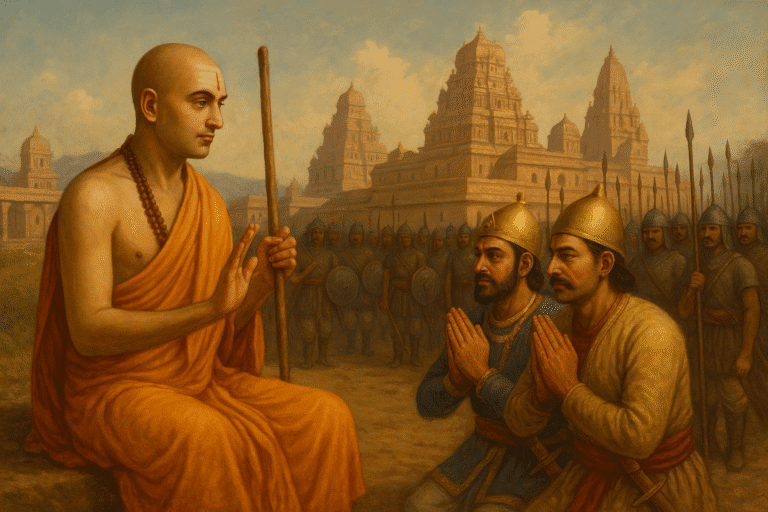
A key historical episode involving Vidyaranya centers around Hakka and Bukka, two brothers who had once served under the Delhi Sultanate. After a period of captivity and forced conversion, they returned seeking counsel. Vidyaranya is said to have mentored them, offering both spiritual guidance and strategic insight.

With his support, the brothers went on to establish the Vijayanagara Empire in 1336 CE. This empire would later become a center for cultural and administrative revival in southern India, playing a role in preserving local traditions and institutions during a time of external pressures.

A Note on His Brother: Sage Sayana

Sri Vidyaranya’s legacy is further enriched by his brother Sage Sayana, a prominent Vedic scholar in his own right. Sayana is most renowned for his extensive commentaries on the Rigveda, Yajurveda, and Atharvaveda, compiled under royal patronage. A particularly intriguing aspect of Sayana’s work is a passage often cited in discussions about ancient Indian knowledge of the speed of light. In a commentary on the Rigveda, Sayana refers to light traveling “2202 yojanas in half a nimesha,” which, when calculated, approximates the modern speed of light.

While this has generated debate in both academic and nationalist circles, scholars remain divided. Some believe it to be a later interpolation or symbolic in nature, while others view it as a remarkable insight into ancient Indic scientific thought. Nonetheless, Sayana’s contributions reflect the high level of intellectual engagement within Vidyaranya’s circle.

Why He Remains a Figure of Interest Today

  1. Interlinking Dharma and Policy: Vidyaranya’s efforts exemplified a thoughtful integration of philosophical ideals with practical governance.
  2. Scholarly Contributions: His works, such as the Panchadasi, contributed significantly to the understanding of Advaita Vedanta and continue to be studied in academic and spiritual circles.
  3. Preservation of Institutions: Under his influence, there was renewed focus on the restoration of temples and learning centers that had been affected during earlier periods of conflict.
  4. Strategic Legacy: His role in the formation of the Vijayanagara Empire highlights his vision for organized resistance and structured revival.
  5. Pan-Indic Vision: His contributions were not confined to one region; they had implications for the broader cultural and civilizational landscape of Bharat.

A Scholar’s Role in Shaping Governance

Sri Vidyaranya’s work is a rare example of a spiritual leader engaging with statecraft without compromising on values. As an advisor, he helped shape the moral and political direction of rulers while staying rooted in the core principles of Dharma.

His influence offers an early model of leadership where intellectual depth and administrative action were not seen in opposition but as complements to one another.

Reflections in Contemporary India

  • Some institutions and educational frameworks look back at Vidyaranya’s model for its emphasis on value-based governance.
  • His blend of scriptural understanding and public policy remains relevant in discussions around cultural preservation and national identity.
  • Organizations focused on Indic studies and heritage conservation continue to draw from his methods.

Sri Vidyaranya’s contributions stand as a testament to how philosophical insight can inform and support pragmatic action. His life illustrates the role that thoughtful leadership, rooted in knowledge and purpose, can play during challenging historical transitions.

In remembering him, the emphasis is not merely on reverence but on learning — understanding how ideas, when applied with clarity and responsibility, can contribute meaningfully to the continuity of a civilization.

His legacy encourages reflection: that resilience is often born at the intersection of thought and action.
PM Modi Dials Elon Musk: A Convo for Transfiguration of the Future of humanity?


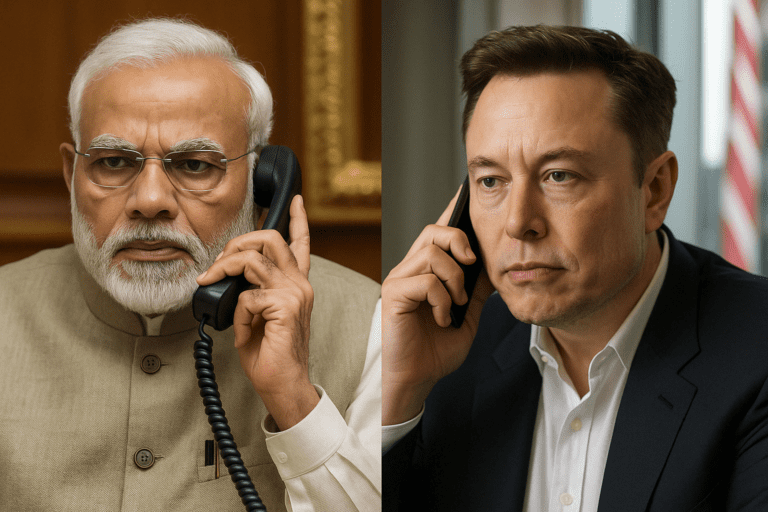
In a world where geopolitics and innovation often collide, few conversations resonate with as much strategic depth as the recent exchange between India’s Prime Minister Narendra Modi and tech titan Elon Musk. In a statement that has since reverberated across policy think tanks and global markets alike, PM Modi reiterated India’s “commitment to advancing partnerships” — a phrase that, while brief, carries with it vast implications for technology, trade, and geopolitical alliances.

But this isn’t just another diplomatic nicety. This is a recalibration. A signal. A story waiting to unfold.


🚀 The Context: Why Now?

To understand the gravity of this conversation, one must first look at the shifting tectonics of the global trade landscape. With the US-China trade war intensifying, and supply chains increasingly rerouted through Southeast Asia, India’s role as a resilient, democratic, innovation-driven alternative has never been more significant.

Elon Musk, the visionary behind Tesla, SpaceX, Starlink, and Neuralink, has long eyed India — a market with 1.4 billion people, growing disposable income, and a thriving youth startup ecosystem. Yet, several bottlenecks have delayed deeper engagement, including regulatory hurdles and import tariffs on electric vehicles.


📞 The Call That Changes Course

In their most recent conversation, PM Modi and Elon Musk re-established momentum for bilateral synergy. According to NDTV and other Indian media outlets, Modi conveyed a strong message: India is open for futuristic business — with simplified pathways, reduced policy frictions, and a government actively rooting for innovation.

This is not the first time they’ve spoken. But the tone this time was different — more collaborative, more targeted. And it happened at a time when Musk is seeking diversified manufacturing bases for Tesla and regulatory clearance for Starlink’s satellite internet rollout in rural and semi-urban India.


⚙️ The Three Frontiers of Partnership

1. Electric Vehicles (EVs) & Tesla’s India Entry

Modi’s government has already announced a policy framework aimed at attracting EV manufacturers through tax breaks, reduced tariffs, and production-linked incentives (PLIs). Tesla’s potential entry into the Indian market could not only revolutionize the luxury EV segment, but also stimulate the EV supply chain — from lithium batteries to gigafactories.

What’s in it for India?

  • Job creation in manufacturing and R&D
  • Technology transfer in sustainable mobility
  • Reduction in fossil-fuel dependency

2. Starlink & the Rural Digital Revolution

With over 300,000 Indian villages still lacking stable internet, Starlink’s satellite-based broadband could be a game-changer. PM Modi, with his vision for a “Digital Bharat,” has already been pushing for BharatNet and last-mile connectivity. A collaboration with Starlink could catapult India’s rural internet speed from 2G/3G to space-grade bandwidth.

Think e-learning, telemedicine, AI-powered agriculture — all possible in villages that were once off the map.

3. Space, AI, and Beyond

India’s ISRO and Musk’s SpaceX are both trailblazers in their own right. While ISRO focuses on frugal innovation, SpaceX dominates commercial launches. A convergence of these two could mean collaborative low-earth orbit projects, student launch programs, or even AI-driven space monitoring tools.

Additionally, Modi and Musk discussed Artificial Intelligence — a field where India has talent, and Musk has vision. From autonomous cars to humanoid robotics, a joint sandbox for AI innovation could redefine the startup ecosystem for both countries.


🗺️ Geo-Economic Implications

Let’s not forget — this dialogue occurred amidst the backdrop of global tech decoupling. With rising pressure on Western companies to shift operations out of China, India becomes an attractive pivot point. Elon Musk, already under scrutiny in the US for his global dependencies, sees India as both a market and a manufacturing base — and rightly so.

This isn’t just about products. It’s about positioning.

  • India wants to be the “factory of the democratic world”.
  • Musk wants resilient, innovation-forward partners.
  • Together, they check each other’s boxes.

🌱 Human-Centric Tech Diplomacy

What’s inspiring about this conversation isn’t just the economics — it’s the philosophy behind it. Modi has long championed “Tech for Good”, while Musk, for all his maverick ways, envisions tech that extends life, solves energy crises, and connects the unconnected.

This rare ideological alignment is a story of hope in a time when technology is often viewed through the lens of surveillance, addiction, or manipulation. Here are two figures discussing connectivity, clean energy, and cross-planetary futures — in a spirit of collaboration, not conquest.


🔍 A Perspective Worth Considering

While it’s tempting to reduce this conversation to a transactional EV deal, that would be missing the forest for the trees.

This call is a marker of India’s growing confidence on the world stage — not just as a buyer, but as a builder of technology. And Musk? He’s no longer just looking for emerging markets. He’s searching for emerging partners.

The tone was optimistic. The intent, strategic. And if followed through, this could be the turning point for India’s global tech narrative.


🟢 In Summary:

  • PM Modi reaffirms India’s commitment to future-facing partnerships.
  • Tesla’s India entry and Starlink’s rollout are on the discussion table.
  • A collaborative roadmap could touch EVs, internet access, space tech, and AI.
  • The call reflects India’s strategic ascent as a global innovation ally.

If even a few seeds from this conversation are watered into reality, the implications will be massive — not just for India, or Musk, but for the billions who stand to benefit from visionary partnerships rooted in purpose. 🌍⚡

Ajmer Dargah Dispute: Why Vishnu Gupta’s Temple Claim Deserves National Support

0

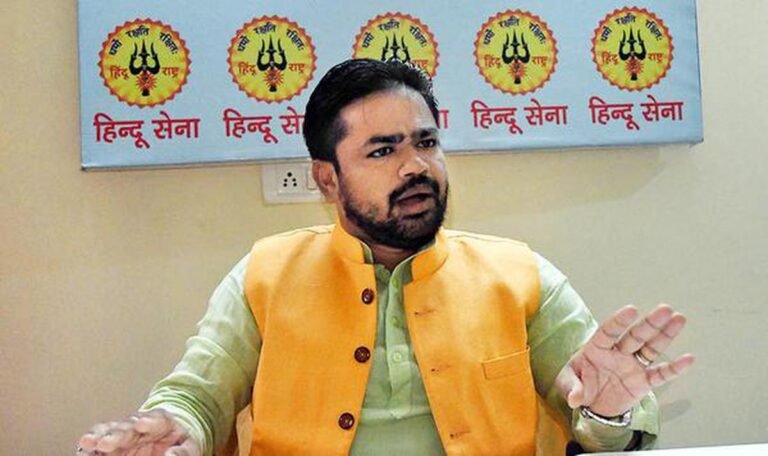
A historic legal storm is brewing in the heart of Rajasthan, as Hindu Sena president Vishnu Gupta has stirred national attention by filing a petition that claims the Ajmer Dargah Sharif was originally a Sankat Mochan Mahadev Temple. This bold move, which many see as an act of historical reclamation, is now the subject of intense court proceedings, spiritual introspection, and political debate.

The Core of the Controversy

In September 2024, Vishnu Gupta filed a civil suit in the Ajmer Court, citing historical texts like Ajmer: Historical and Descriptive by Har Bilas Sarda (1911), which suggest that the revered dargah may have been constructed over a pre-existing Shiva temple. The petition argues that several architectural elements—like temple-style pillars and water tanks resembling those in Hindu shrines—remain intact, pointing to a sacred past.

The plea demands an Archaeological Survey of India (ASI) survey at the dargah site to verify these claims. The court, recognizing the petition’s weight, has issued notices to the ASI, the Dargah Committee, and the Ministry of Minority Affairs. The next court hearing is scheduled for April 19, 2025.

Resistance and Pushback

Expectedly, the Anjuman Syedzadgan (the hereditary caretakers of the dargah) filed a writ petition in the Rajasthan High Court to stop the civil court proceedings, citing the Dargah Khwaja Saheb Act, 1955. However, the Central Government, through Additional Solicitor General R.D. Rastogi, stated that the Anjuman Committee isn’t a party in the original case and thus has no standing to obstruct the case legally.

The Hindu side remains resolute.

Why This Matters

This case is not just about land or bricks—it’s about truth, heritage, and the dignity of our Sanatan Dharma. Across India, there have been hundreds of instances where temples were either destroyed, built over, or erased from public memory. The Ajmer petition is part of a larger movement to reclaim what has been lost—through legal means, rooted in evidence, not emotion.

Vishnu Gupta represents a generation of modern-day warriors who are using the law, history, and democratic tools to protect and preserve Hindu identity. These individuals risk their reputations, face immense backlash, and stand firm against powerful lobbies—all in the service of dharma.

Call to Action

It is time we support such voices—not with hatred, but with courage, unity, and awareness. Whether you are a devout Hindu, a believer in justice, or simply someone who values India’s true history, this is a moment to stand with Vishnu Gupta and other Hindutva warriors who are fighting not against anyone, but for the truth.

Let us not be silent spectators while history is debated in the courts. Let’s amplify this cause on social media, in our communities, and in public discourse.

Sanatan is not just a religion—it is our civilization’s soul. And it’s time we protect it.

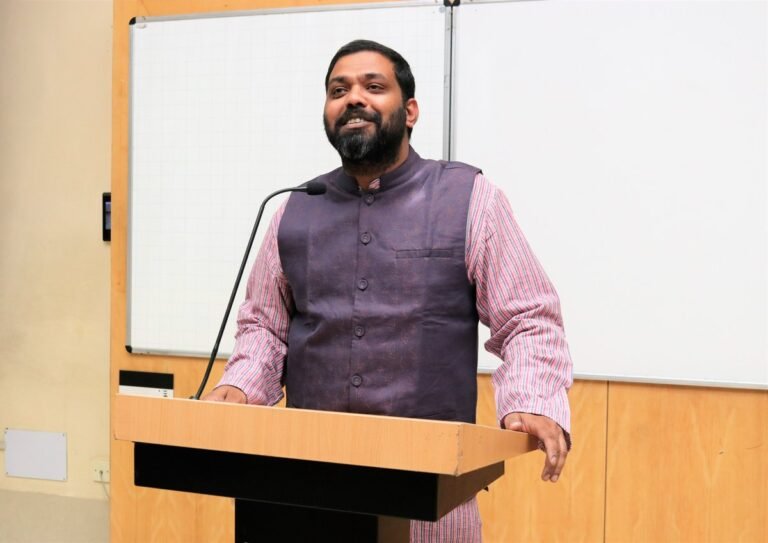
How Professor Subin Sudhir is Leading the Roadmap of AI’s Future in India at IIM Indore

0

In a country where tradition and technology often dance in tandem, one educator is sketching a future that’s not just intelligent—but inclusive. Professor Subin Sudhir, Associate Professor of Marketing at IIM Indore, has emerged as a visionary figure driving India’s AI evolution, especially where it intersects with human values and business transformation.

With a rare blend of academic rigor, industry foresight, and grassroots sensitivity, Subin isn’t just witnessing the AI revolution—he’s designing its blueprint for India.


Bridging Academia and Application

At IIM Indore, Professor Subin Sudhir is known not just for what he teaches—but for how he makes AI relatable. His pedagogy intertwines data science with marketing psychology, artificial intelligence with storytelling, and automation with ethics.

What sets him apart is his commitment to demystifying AI—not just for coders and executives, but for everyday professionals. He helps his students and corporate participants understand AI not as a cold algorithm, but as a tool that can enhance empathy, efficiency, and economic resilience.

His curriculum emphasizes:

  • Real-life Indian use-cases in small towns and startups.
  • AI models built for multilingual and multicultural environments.
  • A strong emphasis on AI for Good—particularly in healthcare, education, and farming.


Redefining What AI Means for India

Unlike many who view AI through the lens of automation alone, Professor Subin champions AI as a social transformer. He advocates for AI models built for:

  • Rural education delivery
  • Primary healthcare diagnostics
  • Indian language natural processing
  • Small business scalability

Through mentorship and strategic guidance, he has helped several startups scale innovations in tier-2 and tier-3 towns, proving that India doesn’t need Silicon Valley’s AI. It needs Bharat-ready AI.


Ethics, Empathy, and Indian Values

In an increasingly data-dominated world, Professor Sudhir’s voice is one of ethical clarity. He speaks frequently on:

  • AI and surveillance overreach
  • Biases in training data sets
  • The impact of unchecked automation on employment

His view is that India’s AI journey must be grounded in its constitutional spirit—justice, equality, and dignity for all. To him, AI isn’t just code. It’s conscience.

“We must build AI that understands not just context, but compassion,” he often says.


AI Education Beyond the Elite

Professor Subin Sudhir is actively working to democratize AI knowledge. From school outreach programs to workshops for women and rural professionals, his mission is to make AI less intimidating and more empowering.

He’s helped create learning modules that work even on low bandwidth, offered regional language resources, and built curriculums for working professionals in non-tech fields.

In his words, “AI is no longer optional knowledge. It’s the new literacy, and everyone should have access to it.”


Vision 2030: A Nation Powered by Purpose-Driven AI

When asked about India’s AI roadmap, Professor Subin outlines a clear, actionable, and deeply hopeful vision:

  • AI-driven public governance with real-time citizen feedback
  • AI tutors delivering personalized education to children in tribal areas
  • Smart agriculture systems predicting yield patterns for every village
  • Ethical marketing practices that use AI to enhance—not exploit—consumer behavior

This isn’t just a tech dream. It’s a socio-technical vision—where progress is measured not just by GDP, but by how many lives were improved by thoughtful innovation.


The Torchbearer of India’s AI Awakening

As India stands on the brink of a data-powered decade, Professor Subin Sudhir emerges as a rare and essential leader—rooted in values, driven by impact, and powered by vision.

He’s proving that AI isn’t just for machines—it’s for a better humanity.

Through his leadership at IIM Indore, public engagement, and his ground-up approach to innovation, Subin is not only guiding minds—he’s awakening a movement. A movement that ensures India’s AI future is not just brilliant—but beautifully human.


IIM Indore’s Flagship Executive Programme: Where AI Meets Marketing

One of Professor Sudin’s most powerful initiatives is the Executive Programme in Marktech and AI-Driven Marketing at IIM Indore—a 12-month course designed for mid- to senior-level professionals who want to lead digital transformation in their industries.

🌟 Course Snapshot:

  • Duration: 12 months
  • Format: 125 hours of live online sessions
  • Immersion: 3-day campus experience at IIM Indore or Mumbai
  • Focus Areas:
    • AI-powered consumer behavior analysis
    • Marketing automation using predictive analytics
    • Customer lifecycle management tools
    • Personalization engines and Martech stacks
  • Certification: IIM Indore Certificate + Executive Alumni Status

This program, conceptualized and led by Professor Subin, has been hailed as one of India’s most future-facing educational innovations—blending theory, tools, and real-world implementation.

🎓 Apply or Learn More Here:
👉 Executive Programme in Marktech and AI-Driven Marketing – IIM Indore via Jaro Education

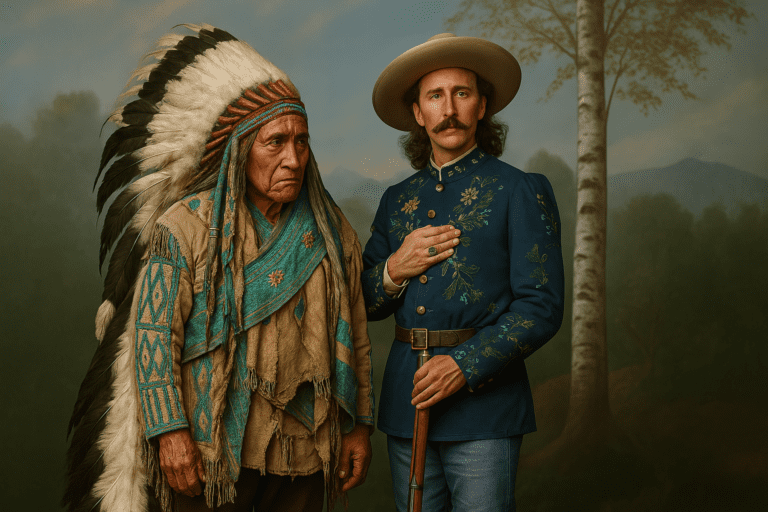
How White Americans Can Help Native Americans and Protect Their Culture: A Journey Toward Healing and Justice

0

There is a silent truth beneath the foundations of the United States—one that cannot be ignored any longer. While the story of America is often told as one of liberty and opportunity, it’s also a story deeply intertwined with colonial violence, cultural erasure, and broken promises made to its first peoples—the Native Americans.

Today, Native American communities are reclaiming their voices, land, languages, and stories. But the journey toward true justice and equality is not one they can or should walk alone. White Americans, as citizens of the same country, can play a pivotal role in not just supporting Native communities, but also in restoring the dignity and culture that centuries of injustice tried to erase.

Let’s explore how that support can take shape—and why it matters more than ever.


📜 A Glimpse into the Past: A History of Pain, Resilience, and Injustice

Long before Columbus set sail or the Pilgrims landed, the land we now call the United States was home to over 500 distinct Native nations, each with its own language, laws, and way of life.

The arrival of European settlers in the 1600s marked the beginning of a slow and calculated displacement. One of the most tragic chapters in U.S. history was the Indian Removal Act of 1830, which authorized the forced relocation of Native tribes to lands west of the Mississippi. This led to the Trail of Tears, during which over 60,000 Native Americans were uprooted, and thousands died due to exposure, hunger, and disease.

In addition to land theft and physical violence, cultural genocide was widespread. The boarding school system, active well into the 20th century, removed Native children from their families, cut their hair, banned their languages, and punished them for practicing their traditions. This form of assimilation wasn’t just cruel—it attempted to erase Native identity from the national fabric.

Even today, over 370 broken treaties made with Native tribes remain a glaring stain on America’s historical conscience. These betrayals have led to generational trauma and systemic disenfranchisement (meaning: denial of rights or privileges).


🌱 So What Can Be Done Today?

Helping Native Americans is not about pity. It’s about justice, repair, and partnership. Here’s how white Americans—and all non-Native allies—can contribute meaningfully.


1. Educate Yourself, Then Others

Start by learning—not just the history written in schoolbooks, but the stories told by Native voices. Read Native-authored books. Follow Native educators and activists. Watch films and documentaries created by Indigenous directors. Understand the diversity: “Native American” is not one group, but a collective of hundreds of nations with distinct languages, beliefs, and customs.

Why it matters: Education breaks the cycle of ignorance that fuels indifference.


2. Support Native Businesses and Artists

Buy jewelry, clothing, herbal products, art, and literature from Native-owned businesses. Attend powwows and cultural festivals not as tourists, but as respectful learners. Promote Indigenous brands online and offline. This isn’t just economic support—it’s a form of cultural revitalization (meaning: bringing something back to life and strength).

Avoid buying from companies that appropriate Native aesthetics without giving back to Indigenous communities.


3. Respect and Advocate for Tribal Sovereignty

Native tribes are not just communities—they are sovereign nations. This means they have the legal right to govern themselves, their land, and their resources.

Support policies and legislation that protect tribal jurisdiction, especially when it comes to natural resources, education, and justice systems. Advocate against projects like oil pipelines or mining ventures that threaten sacred land.


4. Help Preserve Languages and Traditions

Many Indigenous languages are on the brink of extinction. But across the country, language revitalization projects are giving children and elders a chance to reconnect with their roots.

White Americans can support these efforts by:

  • Donating to language schools
  • Volunteering with Native-run educational nonprofits
  • Helping amplify their cultural campaigns

Every Native language saved is a piece of humanity preserved.


5. Push for Visibility in Schools and Media

Most American schools still teach a deeply Eurocentric version of history. Native Americans are often reduced to footnotes in the story of America, mostly discussed in the past tense.

This must change. Support curriculum reforms that incorporate accurate and empowering Native perspectives. Challenge harmful stereotypes in movies, mascots, and mainstream media.

Visibility is not a token gesture—it’s a vital step toward inclusion.


6. Stand With Native Activism

From Standing Rock to Oak Flat, Native communities have long been on the frontlines of environmental and social justice movements.

Join their causes. Share their petitions. Show up at their rallies (if invited). Offer your skills—legal, technical, creative, or financial—to their campaigns. Solidarity is not about taking over. It’s about showing up and lifting up.


7. Honor the Land You Live On

Many cities and neighborhoods in the U.S. are built on land taken from Native tribes. Begin your meetings or events with a land acknowledgment. Go a step further—research the history of your region, and if possible, give back in tangible ways.

Some non-Native people have started rematriation practices—returning land, profit shares, or portions of income to the tribes whose land they live on. Even symbolic gestures like planting native crops, learning tribal stories, or supporting tribal land trusts can be powerful.


🧠 Vocabulary Boost

  1. Disenfranchisement – (noun) The state of being deprived of rights, especially the right to vote or have power.
  2. Revitalization – (noun) The process of bringing something back to life or strength.

🪶 Final Thoughts: Partnership, Not Pity

We cannot change the past, but we can reshape the future. Helping Native American communities is not about guilt—it’s about courage and commitment. It’s about listening more than speaking, giving more than taking, and recognizing that true patriotism includes standing up for those who were here long before us.

White Americans have a crucial role to play—not as saviors, but as allies. The goal isn’t to “fix” Native communities. The goal is to honor their resilience, support their sovereignty, and protect their culture from further erosion.

By learning, advocating, and giving back, we begin to repair a deeply fractured story. And in doing so, we create space for a future where Native cultures are not just preserved—but celebrated.


The massive Impact of H-1B Visa Hiring Practices on American Workers: A System Skewed Against Its Own People

0


When the H-1B visa program was first introduced in 1990, it was designed to invite the world’s best minds to contribute to the American dream—a collaborative effort where global talent would fill in critical skill gaps and fuel innovation. But in recent years, this very program has come under fire for what many believe is a systematic displacement of qualified American workers in favor of cheaper foreign labor.

This isn’t about xenophobia. It’s about balance—and the concern that the scale has now tipped too far. American professionals, particularly in technology and engineering sectors, are not just competing with foreign talent—they’re often being replaced by it. And not due to lack of skill, but simply because someone from another country is willing to work for far less.

Let’s take a deeper, fact-based look at how H-1B hiring practices are affecting the American job market and why reform is no longer optional—but urgent.


💼 The H-1B Visa: Good Intentions, Flawed Execution

The H-1B visa allows U.S. companies to temporarily employ foreign workers in specialty occupations. With an annual cap of 85,000 visas (65,000 general + 20,000 for advanced U.S. degree holders), the program was created to help fill roles that Americans couldn’t.

But here’s the reality today: many companies are using the program not to fill skill gaps, but to reduce costs. This has become particularly visible in sectors like software development, data analytics, quality assurance, and IT support—fields that plenty of American professionals are already trained in.

In many documented cases, American employees have been laid off and required to train their own H-1B replacements. This is not speculation—it has been reported in companies like Disney, Southern California Edison, and more recently, within certain federal IT departments.


📊 The Economics Behind Displacement

To understand the root of this trend, just look at the numbers.

  • An American software engineer might expect $110,000–$130,000/year.
  • An H-1B worker placed by a staffing agency may receive $65,000–$85,000/year.

That’s nearly a 40% cost reduction for employers. Even after factoring in visa processing fees, legal documentation, and agency commissions, hiring foreign labor often turns out cheaper than keeping experienced American workers.

This strategy is a textbook example of wage arbitrage (meaning: taking advantage of wage differences between markets to cut costs). While legal, this practice has long-term social consequences, especially when adopted at scale.


🧠 Vocabulary Boost

  1. Disenfranchise – (verb) To deprive someone of power, rights, or opportunities.
  2. Arbitrage – (noun) The simultaneous buying and selling in different markets to exploit price differences.

📉 The Social and Structural Impact

1. Wage Depression

With cheaper alternatives available, many companies have started offering lower salaries even to American candidates. Over time, this has led to stagnant wage growth in key fields despite rising demand and inflation.

2. Career Roadblocks

Recent graduates are struggling to secure jobs in fields they spent years preparing for. Many companies prefer ready-to-work H-1B candidates from outsourcing vendors, who come fully trained and cost less.

3. Loss of Job Security

Even high-performing American professionals are experiencing layoff anxiety. The fear of being replaced due to cost—not competence—has eroded trust in long-term employment, especially in the tech sector.


🧾 Real Stories: When Americans Are Asked to Step Aside

In 2015, Southern California Edison laid off hundreds of IT workers. They were instructed to train their H-1B replacements or risk losing their severance packages. The replacements were brought in not because of lack of talent, but because they were cheaper.

Similarly, Disney faced public backlash when it was revealed that American workers in their IT department were replaced by outsourced foreign workers on H-1B visas. The employees, again, were asked to transfer their knowledge.

These cases are not rare exceptions—they represent a growing pattern across industries.


🌍 This Isn’t About Blaming Foreign Workers

Let’s be absolutely clear: H-1B workers are not at fault. Most are well-qualified, hard-working individuals simply pursuing better opportunities—just like anyone would. The real issue lies in the system that allows their labor to be exploited, while sidelining American professionals.

Staffing companies and outsourcing firms have developed models specifically designed to profit from the loopholes in the H-1B system, often at the expense of fairness.


🔍 Regulatory Gaps That Enable Abuse

Here are a few of the most exploited gaps:

  • Wage declaration loopholes allow employers to pay H-1B workers less than market average under vague job titles like “programmer analyst.”
  • No mandatory labor market test means employers aren’t required to prove they couldn’t find a local worker first.
  • Third-party placement abuse lets consulting firms file for H-1Bs en masse and lease workers to client firms, creating a shadow hiring economy.

Until these loopholes are closed, the displacement of domestic talent will continue unchecked.


✅ What Needs to Be Done

To restore balance, reform must be bold, precise, and people-first.

  1. Mandate wage parity: Every worker in the same role, regardless of nationality, must be paid equally.
  2. Implement labor market testing: Employers should prove no qualified American candidate was available before hiring an H-1B worker.
  3. Ban knowledge transfer coercion: Employees should never be forced to train their replacements.
  4. Cap per employer usage: Limit how many H-1B workers a company can hire to reduce dependency.
  5. Strengthen enforcement and audits: Conduct random reviews to catch fake job postings and ghost deployments.

These are not anti-immigration measures—they are pro-fairness reforms that protect the spirit of opportunity America was built on.


📌 Final Thought: Opportunity Must Begin at Home

America has always thrived by welcoming talent from around the world. But when that openness begins to disenfranchise its own citizens, something is fundamentally broken.

The goal is not to build walls. The goal is to build a level playing field, where every worker—local or foreign—is treated fairly, paid justly, and hired based on skill, not cost.

The H-1B program can be a powerful tool for progress—but only if it works with the American workforce, not against it.


Pilkhuwa and Its Rose Gardens: Why This Small Town Is emerging as a Real Estate Treasure

“Of all flowers, methinks a rose is best.” – William Shakespeare, The Two Noble Kinsmen


In the northern stretches of India, nestled in the Ghaziabad district of Uttar Pradesh, lies a town most people drive past without noticing. But beneath its modest surface, Pilkhuwa is undergoing a quiet transformation. Once known only for its traditional handloom industry, this serene town is fast becoming a destination of real estate promise—and the reason may surprise you: roses.

Yes, you read that right. The same flowers that symbolize love and beauty are now seeding the path for Pilkhuwa’s rise as one of North India’s most promising real estate hotbeds. With its rich natural beauty, affordability, expressway connectivity, and global appeal, Pilkhuwa is ready for the spotlight.


🌹 Where Roses Aren’t Just Grown—They Guide Growth

For generations, Pilkhuwa has been home to sprawling rose gardens—especially known for growing Damask roses and desi gulab. These are used not only in religious ceremonies but also for producing rose oil, water, perfumes, and even Ayurvedic medicines. The region’s fertile soil, low pollution, and ideal climate make it perfect for growing high-value flowers.

But these aren’t just fields of beauty—they’re now becoming symbols of lifestyle, attracting those who want to own land that breathes life and fragrance.

The soft hum of rose pickers at dawn, the earthy perfume wafting through narrow paths, and the deeply ingrained floral economy have given Pilkhuwa a rare idyllic (meaning: extremely peaceful and picturesque) charm—something buyers from Delhi and beyond are waking up to.


🛣️ A Game-Changer Called NH-24

For any location to boom in real estate, connectivity is key. Pilkhuwa scores big here.

Located just off the Delhi-Meerut Expressway (NH-24) and linked via the Eastern Peripheral Expressway, Pilkhuwa is now just 45–50 minutes from Delhi and even closer to Noida and Ghaziabad. Add to that the soon-to-be-operational RRTS (Regional Rapid Transit System) and you’ve got one of the most strategically positioned towns in the NCR belt.

It’s close enough to stay connected to the capital’s job markets, yet far enough to enjoy peace, clean air, and affordability.


🏡 The Rise of Uber-Luxury Farmhouses in Rose Country

Perhaps the most exciting real estate trend in Pilkhuwa is the growing demand for luxurious farmhouses that blend natural living with modern indulgence.

From Delhi’s elite to wellness entrepreneurs, buyers are now purchasing 500 to 1,200 sq. yard plots in Pilkhuwa to develop:

  • Spa-equipped private villas
  • Fruit gardens and herbal orchards
  • Solar-powered eco-retreats
  • AI-enabled smart homes with countryside views

According to Shivam Sharma, Sr. Consultant at AAAI Reality, a leading farm estate consulting firm, “There’s a clear shift in buyer preference. HNI clients are moving away from boxed apartments and choosing to invest in experiential living. Pilkhuwa is offering countryside calm with city convenience—and that’s a rare combination.”

From rose garden-facing verandahs to curated landscaping with native plants, the farm estate lifestyle is now being redefined in Pilkhuwa.


🌍 Global Citizens Are Setting Roots Here

Interestingly, the town isn’t just drawing Indians—it’s attracting global settlers too.

Ms. Stephanie Ellison, a wellness expert from Texas, USA, is setting up a strawberry farm on the outskirts of Pilkhuwa. Her vision includes weekend stay options, organic food experiences, and nature therapy workshops.

Meanwhile, Julia, a Russian nature-lover and permaculture designer, has purchased land here to develop a fruit forest-style retreat. She chose Pilkhuwa not just for affordability, but for what she calls its “perfect blend of silence and access.”

As Julia puts it:

“It’s rare to find land that’s this rich, this affordable, and this well-connected to a major city like Delhi. Pilkhuwa is a countryside gem with global potential.”

This growing international interest is further validating Pilkhuwa’s real estate value—and giving it an aspirational identity among elite buyers.


📈 The Numbers Don’t Lie

With land prices currently ranging from ₹15000 to ₹60000 per square yard based on the location within town, Pilkhuwa is significantly more affordable than areas in Noida, Gurugram, or even Ghaziabad. Yet the returns here are no less promising. Builders and planners are projecting a 25–40% appreciation in 3–5 years owing to:

  • Expressway expansion
  • Increasing demand for second homes and farm stays
  • NRI investments and private township proposals

The availability of ready infrastructure—roads, power lines, water supply, fiber-optic internet—makes it even more viable for immediate construction and development.

In real estate terms, that’s a viable (meaning: capable of working successfully) sweet spot: low entry, high return, low risk.


🧘‍♂️ Wellness and Legacy Living

With more people choosing conscious living over cramped urban chaos, Pilkhuwa’s image is shifting. It’s no longer “just a town”—it’s a wellness canvas.

You’ll find:

  • Organic farming initiatives
  • Ayurvedic rose distilleries
  • Nature retreats and yoga centers
  • Eco-conscious builders creating chemical-free homes

This aligns beautifully with the slow living movement, making Pilkhuwa a go-to destination for those seeking calm, connection, and clarity—without compromising on lifestyle.


🏫 Schools, Services & Social Growth

And let’s not forget civic development. Pilkhuwa is no longer rural in the traditional sense. Some promising signs of urban evolution:

  • Reputed CBSE schools opening new branches
  • Hospitals from Ghaziabad and Hapur expanding services here
  • Rise of co-working spaces and cafes for digital nomads
  • Smart city planning influence seeping in

All of this makes Pilkhuwa livable—not just visit-worthy.


📊 Summary Snapshot: Why Pilkhuwa Is Hot Property

FactorImpact
NH-24 & Expressway proximity3x increase in land inquiries (2022–2024)
Farmhouse & villa boom500+ active buyers seeking rose-view properties
Global interestUSA, Russia, and UAE buyers entering the market
Affordable pricing₹7,500–₹18,000/sq yd compared to ₹45,000 in NCR
Eco & wellness trendFarm stays and Ayurvedic centers gaining traction

🧠 Vocabulary Boost

  • Idyllic – (adj.) Extremely peaceful, happy, or picturesque.
  • Viable – (adj.) Capable of working successfully; feasible.

🌸 Final Word: Pilkhuwa Is No Longer in the Shadows

This is not a town to overlook anymore. Pilkhuwa isn’t just selling land—it’s offering legacy. It’s not just green; it’s gold with a rose tint. And as more individuals—Indian and global—seek land that speaks to both the heart and the head, Pilkhuwa is rising, petal by petal, plot by plot.

Whether you’re an investor, a builder, or someone looking to live where the air smells of roses and possibilities—Pilkhuwa is the place for future’s farm style living.


Pandit Shri Hari Om Sharma – A saga of Music, Arts and Cultural Integrity

0

Pandit Shri Hari Om Sharma– A saga of Music, Arts and Cultural Integrity

Pandit Shri Hari Om Sharma ji has spent over five decades shaping the cultural and educational landscape of Ghaziabad and beyond the borders of nation. As the Adhyaksha of Sanskar Bharti Ghaziabad, he has played a vital role in nurturing traditional Indian art, music, and literature through a combination of grassroots leadership and hands-on mentorship.

Born with a natural affinity for the arts, Pandit Shri Hari Om Sharma ji has built his life around classical music, Sanatan values, and teaching. His early association with the Rashtriya Swayamsevak Sangh (RSS) gave him a strong foundation in discipline and nation-first thinking, which later guided his work in music and education.

Decades of Teaching Rooted in Indian Knowledge Systems

For many years, he served as Head of Department at Sanatan Dharma Inter College in Ghaziabad, where he taught music, Hindi, Sanskrit, and history. His classroom was never just a space for textbook learning—it was where generations of students were introduced to Indian heritage in a living, breathing form.

His teaching style blended structure with intuition, theory with practice. Many of his students recall not just lessons, but stories, shlokas, and raga-based teachings that left a lifelong impression.

Sangeet Kala Niketan – A Living School of Sound

Perhaps one of his most enduring contributions is Sangeet Kala Niketan, the music institute he founded and continues to run for over 35 years. Located in Ghaziabad, this school has trained hundreds of students in Indian classical vocal and instrumental music.

What makes the institute stand out is Pandit Shri Hari Om Sharma ji’s approach—rooted in guru-shishya parampara, yet adaptive to evolving learning styles. Whether it’s tabla, harmonium, sitar, or even Western instruments, he imparts a nuanced understanding of musical emotion, discipline, and cultural context.

More Than a Musician – A Holistic Cultural Personality

Beyond music and education, Pandit Shri Hari Om Sharma ji is also a former state-level hockey player, reflecting a life where mental and physical discipline go hand in hand. His personality is not limited to one domain—he is also known for his deep philosophical understanding of Indian traditions.

During his college days, he penned a reflective article about his life’s purpose and principles, capturing a rare blend of introspection, cultural pride, and personal philosophy.

Leadership at Sanskar Bharti Ghaziabad

As President of Sanskar Bharti Ghaziabad, Pandit Shri Hari Om Sharma ji is actively involved in promoting Indian arts and literature through events, workshops, and mentorship. Under his leadership, the organization has expanded its reach, focusing on small cultural units that engage with communities at a grassroots level.

He remains committed to creating platforms for both established and emerging artists, while also fostering awareness of India’s literary and cultural wealth among youth.

King Leopold II: The Ghost King Who Killed 10 Million Africans—And Still Escaped Judgment


King Leopold II: The Ghost King Who Killed 10 Million Africans—And Still Escaped Judgment

By HawkFeed News | The History They Don’t Want You to Remember


Who was King Leopold II? A European monarch? Yes. A master of manipulation? Definitely.
But above all, he was one of the deadliest men in recorded history.

And yet—his name rarely stirs outrage. Why? Why has the world forgiven—or forgotten—a man whose regime butchered, starved, and mutilated over 10 million Africans?

This isn’t just a history lesson. This is a reckoning.


The Rise of the Butcher King

Born in 1835, Leopold II was the second King of Belgium. By all accounts, he was a frustrated royal. Belgium was small, landlocked, and not as powerful as its imperial peers—Britain, France, Spain.

But Leopold had a dark dream: he wanted a colony to make Belgium rich—and himself richer.

So, in the late 19th century, during the “Scramble for Africa,” he seized his chance. He didn’t just colonize Congo through the Belgian state. Oh no—he did something far more sinister.

He bought the Congo as personal property.

Yes, you read that right. In 1885, under the guise of humanitarian aid and “civilizing the savages,” Leopold convinced Europe to grant him ownership of what became the Congo Free State—a land 76 times bigger than Belgium.

From that moment on, Congo was not a colony. It was a plantation, a prison, a slaughterhouse—all owned by one man.


What Happened in the Congo?

Leopold’s empire was built on rubber and ivory, two commodities in high demand due to the industrial boom.

To maximize profit, he established a system of forced labor. Congolese men were kidnapped from villages and ordered to harvest wild rubber from the forests. The quotas were insane. And if they failed?

  • They were whipped with the chicotte—a cruel whip made from animal hide, capable of tearing skin off the bone.
  • Their wives and children were taken hostage, often raped or starved.
  • Hands were cut off to prove bullets weren’t wasted.
  • Villages were burned. Babies were killed. Men were executed.

It wasn’t just brutality—it was a business model of fear.

The soldiers, known as the Force Publique, operated under one rule: Meet the quota, or eliminate the workers. And the world? It looked away.


How Many People Did He Kill?

The numbers are chilling.

Historians estimate that over 10 million Congolese people died under Leopold’s regime between 1885 and 1908. That’s nearly half of the entire population at the time.

“The loss of life was so vast it resembled a silent genocide,”
Historian Adam Hochschild, author of King Leopold’s Ghost

But why such a massive death toll?

  • Forced labor killed thousands through exhaustion, beatings, and execution.
  • Starvation followed as men were taken from fields and villages stopped farming.
  • Disease spread due to overcrowded labor camps and malnutrition.
  • Psychological collapse and suicide soared as entire communities were destroyed.

And here’s the sickening part—Leopold never set foot in Congo. He orchestrated it all from his palace in Brussels while receiving billions in modern-day profits.


How Was This Allowed?

Because he lied to the world—and the world believed him.

Leopold painted himself as a philanthropist. He claimed to be on a Christian mission to end the Arab slave trade and bring civilization to Africa.

And to an extent, it worked. For years, the world bought the myth.

Until a few brave individuals began speaking out.

  • George Washington Williams, an African-American journalist, called it what it was in 1890: “A secret, barbarous slave state—a crime against humanity.”
  • E.D. Morel, a British clerk, noticed that ships from Congo carried only rubber and ivory out, and guns and chains in.
  • Roger Casement, an Irish diplomat, traveled to Congo and published a damning report based on survivors’ testimonies.

Their efforts sparked the first major international human rights campaign of the 20th century.


The Fall of the Tyrant—Or Was It?

By 1908, public pressure forced Leopold to relinquish control of Congo. But he was never held accountable. In fact, he destroyed most of his records before his death in 1909.

When he died, Belgians celebrated him as a hero. Streets, statues, and buildings were named after him.

And the Congo? It was handed over to the Belgian government, which continued exploitation—only with better PR.

There were no trials. No reparations. No global reckoning. Just silence.


Why Don’t We Talk About This?

Let’s ask the hard questions:

  • Why is King Leopold II not taught in schools alongside Hitler or Stalin?
  • Why aren’t there museums or movies or remembrance days for his victims?
  • Why does Belgium still have statues honoring him?

Because he was European. Because his victims were African. And because history protects the hands that write it.

The West has long struggled to confront the horrors of colonialism. It’s easier to label it “civilization” than admit it was a genocide wrapped in greed.


Congo Today: The Unhealed Wound

Modern-day Democratic Republic of Congo still suffers from the aftershocks of Leopold’s rule:

  • Instability and corruption rooted in the vacuum of post-colonial power.
  • Mass poverty in one of the world’s most resource-rich nations.
  • Generational trauma in communities that lost their elders, culture, and land.

Congo bleeds not just from new wounds—but old scars that were never treated.


Final Thought: What If the World Remembered?

Imagine if we told every child in school about Leopold II.
Imagine if we honored Congolese victims like we do those of Auschwitz.
Imagine if Europe truly reckoned with its colonial crimes—not with regret, but with responsibility.

Because King Leopold II wasn’t a footnote. He was a butcher with a crown, a businessman of genocide, a symbol of everything dark and unrepented in colonial history.

And 10 million souls deserve more than silence.


Quote 1:
“Leopold never went to Congo. He never held a whip. But he ruled like God and killed like Satan.”
Congolese oral historian, unnamed survivor account

Quote 2:
“The silence around Leopold is not accidental. It is chosen. It is whitewashed. It is history’s dirtiest secret.”
Journalist E.D. Morel


Saurabh Pandey Shaurya – The Storyteller Shaping India’s Digital Awakening

0

In a time where shouting over one another seems to have become the norm in media, Saurabh Pandey Shaurya stands out as a refreshing exception — a storyteller who doesn’t just report facts but nurtures a narrative, adding depth, direction, and dignity to digital journalism. From hosting thought-provoking interviews to building media platforms that inspire, Saurabh is not just a journalist — he’s a bridge between truth and transformation.

Let’s take you through a fascinating journey of a man who believes in the power of shaant (calm) conversation over sensational chaos.


A Digital Torchbearer

Saurabh Pandey Shaurya isn’t your typical news anchor. His calm voice, composed demeanor, and choice of content reflect his belief that media is not just about breaking news but breaking stereotypes.

He currently serves as the Editor of The Chaupal, a rising digital media platform that takes pride in its roots while boldly embracing modern narratives. Under his editorial leadership since 2018, The Chaupal has grown to become a space where traditional values meet today’s youth voices — making it both relatable and reliable.

But his role doesn’t end at being an editor. He is also a media strategist, interviewer, content creator, and an active contributor to India’s political youth voice.


What Makes Him Unique?

There are many journalists. There are many influencers. But there are very few who understand the responsibility that comes with being a public storyteller. Saurabh’s storytelling is grounded, respectful, and aimed at driving clarity, not conflict.

What truly sets him apart is his ability to ask the right questions — not the loud ones, but the necessary ones.

✦ Example: The Major Gaurav Arya Interview

One of Saurabh’s most admired interviews is with Major Gaurav Arya, a former army officer and celebrated public speaker. The conversation wasn’t just patriotic fluff. It was nuanced, emotional, and intelligently navigated — allowing audiences to feel, think, and understand. That’s his gift: turning complex subjects into human stories.


More Than Just a Journalist

Saurabh wears multiple hats with ease. While most people know him for his media work, fewer know that he’s also:

  • A poet and a writer, often reflecting on themes of culture, society, and identity.
  • An anchor, hosting shows that explore everything from governance to ground realities.
  • A political communicator, playing a key role in the Bharatiya Janata Yuva Morcha (BJYM) — the youth wing of India’s largest political party.

His ability to straddle both creative and strategic worlds makes him a polymath (a person of wide knowledge or learning) in modern media.


Rooted in Values, Aimed at Vision

Saurabh Pandey Shaurya represents a generation of journalists who haven’t forgotten their roots while chasing the future. Whether he’s speaking about Indian youth, development issues, or political philosophy, his words echo sincerity.

He brings “Desi Intelligence” to Digital Platforms — meaning, his content isn’t just highbrow for the sake of sounding smart. It’s smart in how well it understands the Indian audience.

His posts are often bilingual, laced with colloquial Hindi phrases and crisp English analysis — a true reflection of how India actually thinks and speaks today.


Digital Presence That Educates

Saurabh is active on platforms like Instagram (@spshaurya68) and Facebook, where he shares not only journalistic updates but also personal observations, inspiring quotes, and reflections on media, youth, and social issues.

What’s impressive is that even while being visible, he avoids falling into the trap of “clickbait culture.” He believes in engagement through insight, not intrusion.

Even his captions and headlines carry a careful craft. One can see the journalistic rigour paired with poetic undertones — reminding us that content can be both sharp and soulful.


A Voice for the Youth

Being a part of the National Media Team of BJYM, Saurabh plays an important role in bridging the communication gap between youth politics and mainstream narratives.

He writes, edits, and contributes to youth-oriented publications, ensuring that political discourse stays civil, intelligent, and inclusive.

He knows that Indian youth are not just voters — they are visionaries. And he uses his media skills to amplify that vision, not manipulate it.


Learning From His Journey

There’s a lot that budding journalists, creators, and communicators can learn from Saurabh:

  1. Speak Less, Say More – In an age of noise, his interviews prove that depth doesn’t need decibels.
  2. Be Curious, Not Confrontational – He doesn’t try to trap his guests; he gives them space to express.
  3. Respect the Medium – Whether it’s digital, video, or print, he knows how to tailor the message without losing the essence.
  4. Stay Grounded – Even with rising fame, his content remains children-safe, community-sensitive, and culturally conscious.

Vocabulary Boost:

  1. Polymath (noun) – A person who knows a lot about many different subjects.
    “Saurabh’s journey proves that in modern media, being a polymath is a superpower.”
  2. Introspective (adj.) – Examining one’s own thoughts and feelings.
    “His interviews often have an introspective tone, inviting both the guest and the audience to reflect.”

Final Thoughts: Why Saurabh Pandey Shaurya Matters

In a country where journalism is often accused of being polarising or performative, Saurabh Pandey Shaurya reminds us of what journalism could be — sincere, sharp, and soaked in substance.

He’s not just “covering” stories — he’s curating conversations.

He isn’t chasing virality — he’s building credibility.

And most importantly, he’s shaping an alternative media ecosystem where thoughtfulness triumphs over theatrics.

For every young person who wants to enter the media world, Saurabh’s path is a living reminder that truth, when told with heart and honour, still resonates louder than any viral soundbite.